
Ashley Down's streets are lined with a good number of period terraces, many dating from the late Victorian and Edwardian era when Bristol was expanding rapidly northwards to house a growing population. These properties were generally built with materials in mind that suited their steep pitches and close-set rooflines, and getting the material choice right when the time comes for a new roof matters as much for how the house looks from the pavement as it does for how well it performs over the coming decades of British weather. A material that suits a 1930s semi will not necessarily suit a Victorian terrace two streets away, which is why we treat this as a per-property decision rather than a default recommendation applied to every job that comes through the door.
Natural slate is the material most commonly associated with this style of home, and for good reason. Welsh or similar hard-wearing slate has a slim profile, a muted grey-blue tone and a long service life that suits terraced streets where roofs are highly visible and often overlooked from upstairs windows of neighbouring properties. Matching the existing slate size, thickness and laying pattern, rather than defaulting to whatever is cheapest or quickest to source that week, helps a replacement roof sit comfortably alongside the rest of the row, and it also tends to hold its value better over the life of the property when the time eventually comes to sell it on.
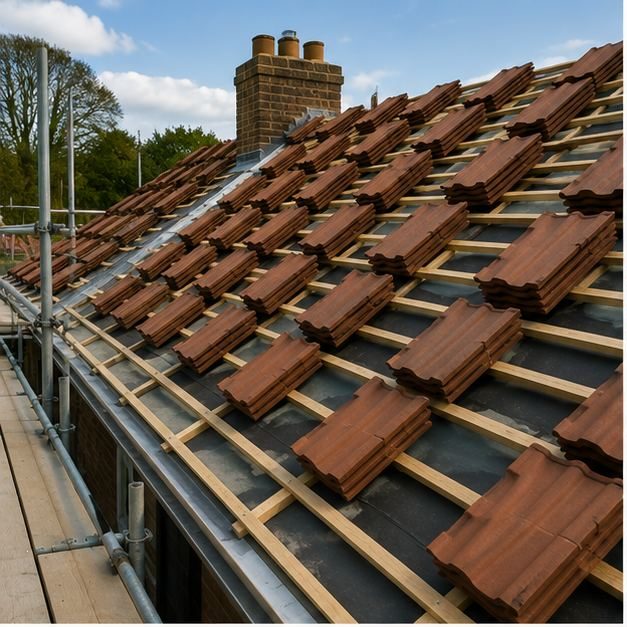
Some period homes in Ashley Down were finished with clay tiles rather than slate, particularly where a property has been extended or re-roofed at some point during its history by a previous owner. Clay plain tiles or pantiles bring a different texture and colour to a roof, and a mismatch between old and new sections can look jarring if it is not handled carefully by whoever is carrying out the work. Where a roof is only partially failing, we often talk homeowners through whether a full replacement in a consistent material makes more visual and practical sense than patching with tiles that do not quite match the surviving originals, since a piecemeal repair can sometimes end up looking worse than the fault it was originally meant to fix.
Newer homes on more recent developments around Ashley Down tend to have a bit more flexibility, since concrete interlocking tiles or manufactured slate alternatives can offer good value and solid, reliable performance without the same conservation considerations that apply to a Victorian terrace nearby. Even here, though, it is worth thinking about how a roof will weather over the coming decades, how it will look once it has faded slightly with age and exposure, and how well it complements neighbouring properties on the same close or cul-de-sac, rather than choosing purely on upfront cost and nothing else.
Because no two roofs in Ashley Down are quite the same, we prefer to inspect a property in person before recommending a material rather than quoting from a standard list over the phone without ever seeing the roof. If you are weighing up your options for a period or more recent home, Brunel Roofing Bristol can talk you through what will genuinely suit your roof's pitch, detailing and appearance, and give you a clear, honest quote for the work involved.
Get a Free Quote for New Roof Installations in Ashley Down
Every roof is different — the fastest way to get an accurate answer is a quick chat with our team.