
Because Portishead sits so directly exposed to wind coming off the Severn Estuary, a new roof here has the opportunity to be specified quite differently from a roof going onto a sheltered inland property, and it is worth making the most of that opportunity rather than defaulting to a standard specification purely out of habit.
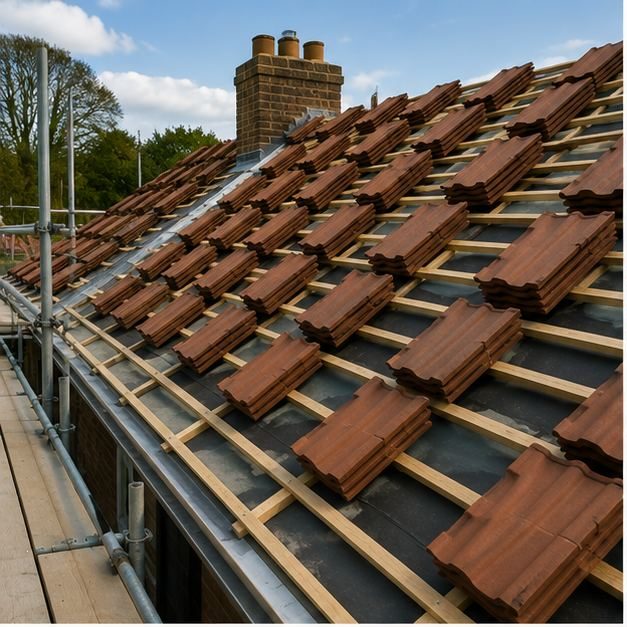
A re-roof is really the only point at which this kind of upgrade makes practical sense, since improving fixing density, ridge detailing or underlay performance on an existing roof piecemeal is rarely cost effective compared with specifying it correctly when the whole covering is being renewed. Homeowners planning a re-roof in Portishead are, in effect, making a decision that will determine how their roof copes with storms for the next several decades, so it is worth spending a little time on the specification rather than treating it as a formality.
Fixing method is one of the most significant factors. Mechanically fixed tiles, secured with nails or clips at every point rather than relying on the tile's weight and overlap alone, resist wind uplift far better than a minimally fixed roof. On a particularly exposed Portishead plot, especially one with a clear run of wind off the water, additional fixing beyond the standard minimum is often worthwhile, and it is a relatively small extra cost within the context of a full re-roof.
Ridge and verge detailing deserve equal attention. Dry ridge and dry verge systems use mechanical clips rather than traditional mortar, removing a weak point that would otherwise be one of the first things to fail in sustained wind. Given how often loose ridge tiles turn up as an early sign of storm-related wear on Portishead roofs, specifying this properly from the outset is one of the more effective long-term investments available during a re-roof.
The choice of tile or slate itself also plays a part. Lighter materials are not automatically the wrong choice, but they do need to be matched to a fixing specification suited to the site's actual exposure rather than a generic one. Brunel Roofing Bristol assesses each Portishead property's specific exposure, from harbourside cottages catching wind straight off the water to marina-area homes on more sheltered inland streets, and specifies the fixing and detailing accordingly rather than applying a single standard approach everywhere.
Underlay is worth a mention too, since it is easy to overlook when discussing wind resistance but plays an important supporting role. A high-performance breathable membrane fitted beneath the tiles acts as a secondary line of defence, keeping the roof structure dry even if wind briefly disturbs the outer covering during an exceptional storm. Pairing a well-specified underlay with properly fixed tiles and dry ridge detailing gives a roof several layers of protection rather than relying on any single element to do all the work.
If you are planning a new roof and want it built to cope properly with Portishead's weather rather than just meet a minimum standard, it is worth discussing wind resistance specifically as part of the specification. Speak to Brunel Roofing Bristol about what that would involve for your property and get a quote based on it.
Get a Free Quote for New Roof Installations in Portishead
Every roof is different — the fastest way to get an accurate answer is a quick chat with our team.