
Chipping Sodbury sits in a part of South Gloucestershire that, like much of the wider Bristol area, gets its share of strong winter storms, and older roofs are often where that weather does the most visible damage. Slipped tiles, lifted ridge caps, and torn felt are common calls after a bad storm, and in many cases the underlying cause is a roof covering that was fixed to a lower standard than current guidance now recommends.
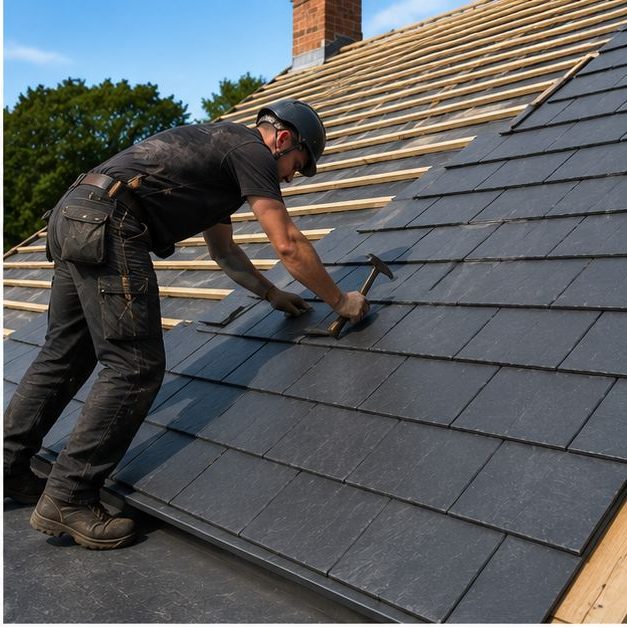
Older roofs in Chipping Sodbury were often laid using nails alone to fix tiles, with ridge tiles simply bedded in sand and cement mortar. Over time that mortar dries out, cracks, and loses its grip, which is exactly when a gust of wind can lift a ridge tile or work a roof tile loose. A new roof installed to current standards uses mechanical fixings for tiles in exposed positions and dry-fix ridge and hip systems that clip and screw into place, giving a much more secure hold than mortar bedding alone.
Underlay plays a role too. Modern breathable membranes are far more robust than the bituminous felt used on many older roofs, and they are installed with proper laps and detailing around penetrations, which gives a second line of defence if wind-driven rain does get past the tiles during a storm. On an older roof where the felt has become brittle, that backup layer may already be failing quietly, even if the tiles above still look intact.
None of this means every roof needs replacing after every storm. But when storm damage becomes a recurring event rather than a one-off, or when a roofer surveying storm damage finds that the fixings and underlay beneath the visible tiles are generally worn out, a full re-roof specified to current standards is often better value than repeatedly repairing the same weak points.
Exposure varies across Chipping Sodbury depending on where a property sits, with houses on higher, more open ground or at the edge of an estate generally taking more of the wind's force than those tucked into a more sheltered street closer to the town centre. A new roof specification can be adjusted to reflect that exposure, using a higher proportion of mechanical fixings or a more robust ridge system on properties that are known to catch the worst of the weather.
Guttering and rainwater goods are also worth reviewing at the same time as the roof covering, since storm damage often shows up as overflowing gutters just as much as lifted tiles. A re-roof is a natural point to check that fascias, soffits, and gutters are in good order too, so the whole roofline is working together rather than the new covering being let down by ageing rainwater goods below it.
If you have had repeated storm damage on your Chipping Sodbury property, or you are simply concerned about how your roof would cope with the next bad winter, Brunel Roofing Bristol can survey the roof and advise honestly on whether repair or replacement makes more sense. Get in touch for an assessment.
Get a Free Quote for New Roof Installations in Chipping Sodbury
Every roof is different — the fastest way to get an accurate answer is a quick chat with our team.