
High winds are one of the biggest tests any roof faces, and modern tile fixing methods have evolved considerably to address this. Rather than relying on the weight of the tile alone to keep it in place, current guidance requires a calculated fixing specification based on the tile type, roof pitch, building height and local wind exposure, which is particularly relevant for the more open, newer-build streets found around Emersons Green where wind can travel with less obstruction than in more built-up, sheltered parts of Bristol closer to the city centre.
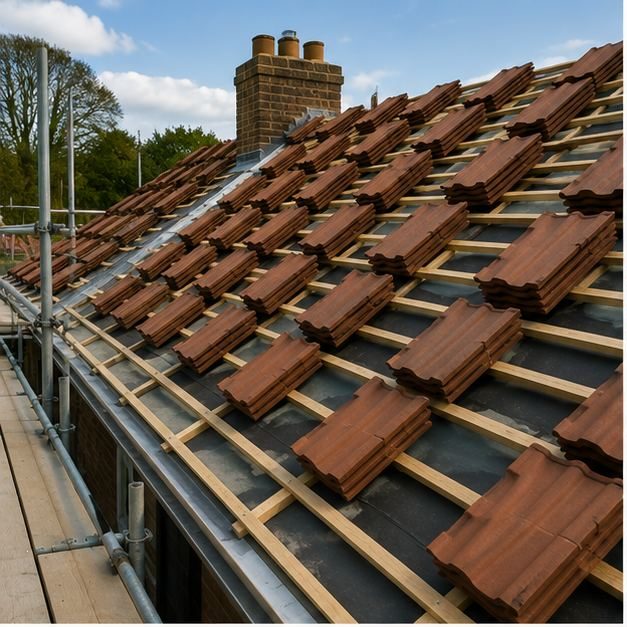
Every tile on a modern roof is typically either nailed, clipped, or both, depending on its position on the roof and the wind uplift calculation for that specific building. Perimeter areas such as verges, eaves and ridges generally need a higher proportion of fixed tiles than the main body of the roof, since these areas experience greater uplift forces during storms. This calculation follows current British Standard guidance rather than a one-size-fits-all rule of thumb, taking into account factors such as the height of the building and how sheltered or exposed the surrounding land is, rather than assuming every roof in the area needs identical treatment.
Mechanical clips have become increasingly common alongside traditional nailing, offering an additional, removable fixing point that holds the tile firmly without the risk of nail corrosion loosening the fixing over time. On some ranges, interlocking tiles are also designed with fixing lugs built into the profile itself, adding a further layer of security beyond the nail or clip alone, and this combination of features is one reason modern roofs generally cope far better with severe weather than older roofs fitted decades ago under less rigorous standards, which were often fixed far more sparingly than would be acceptable today.
Ridge tiles, hip tiles and verge details deserve particular attention in this context, since they are among the first points of failure when a roof is put under real wind pressure. Modern dry-fix systems, using mechanical fixings rather than relying purely on mortar, have largely replaced older methods precisely because they hold up more reliably over time and are less prone to the cracking that traditional mortar bedding can suffer, especially through repeated freeze-thaw cycles over a British winter, when moisture trapped in a hairline crack can quickly widen it further.
Brunel Roofing Bristol fixes every tile according to a proper wind uplift calculation for the specific property, rather than a generic approach, giving Emersons Green homeowners a roof built to withstand the conditions it will actually face through the years ahead. Get in touch for a quote if you would like your roof assessed.
Get a Free Quote for New Roof Installations in Emersons Green
Every roof is different — the fastest way to get an accurate answer is a quick chat with our team.