
Greenbank has plenty of older roofs that have been worked on more than once over the decades, and not every repair job has been carried out to a high standard. From the ground, a poorly repaired roof often gives itself away through small but telling details: patches of tile or slate that don't quite match the surrounding coverings in colour, texture or size, ridge tiles that sit at a slightly different angle to their neighbours, or a visible lump of cement where a proper flashing detail should be. None of these signs are dramatic on their own, but together they tell a story about how the roof has actually been looked after over the years.
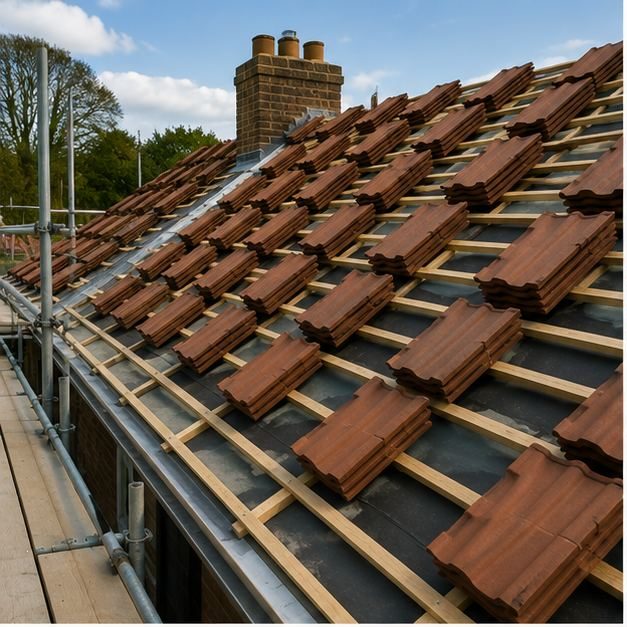
Look closely at valleys and abutments where the roof meets a chimney or a neighbouring wall. These are the areas most likely to have been bodged in the past, because they're fiddly to get right and quick to cover up with sealant or mortar instead of proper flashing work. If you see cracked or discoloured pointing around a chimney stack, a section of roof that looks noticeably newer or shinier than the rest, or tiles that appear to have been simply propped back into place, it's worth asking whether that was a proper repair carried out by a competent roofer or simply a stopgap fix done in a hurry. Roof felt or membrane that has been pushed back into position rather than properly reinstated is another common giveaway, often visible as a slightly uneven line just below the tile edges.
Inside the loft, poor repair work tends to leave clearer evidence than it does from outside. Watermarks on timber, damp patches that appear near a specific point on the roof rather than spread evenly across it, or daylight visible through gaps around flashing are all signs that a previous fix hasn't properly solved the underlying issue. In many Greenbank properties, especially those with older slate or tile roofs, a repair that looks perfectly acceptable from the street can still be letting water in slowly from above, unnoticed until it's caused real damage to timbers or ceilings below. It's also worth checking whether insulation in the loft has become compressed or discoloured in one particular area, since this often points to a slow drip that's gone unnoticed for some time.
The difficulty with poor repairs is that they're often designed to look acceptable rather than to actually last for any length of time. A patch might hold for a season or two before the same problem returns, sometimes worse than before because the surrounding materials have continued to age and deteriorate underneath it. This is a common pattern on Greenbank roofs that have had several small interventions over the years rather than one thorough, considered assessment of the whole roof structure at once. Homeowners often only realise how many small fixes have accumulated once a roofer points them out one by one during a proper inspection.
If you're unsure whether previous work on your roof was done properly, it's worth having it looked at by someone who can assess the whole roof rather than just the visible patch. Brunel Roofing Bristol can inspect a Greenbank roof, explain honestly what's been done to it in the past, and advise on whether further repairs or a full replacement makes more sense for your property, with a free quote to help you make an informed decision either way.
Get a Free Quote for New Roof Installations in Greenbank
Every roof is different — the fastest way to get an accurate answer is a quick chat with our team.