
Many roofs around Shirehampton, particularly on the area's twentieth-century family housing, are hipped rather than gabled, meaning the roof slopes inward on all sides rather than ending in a vertical triangular wall at each end of the building. Where those sloping sides meet, hip tiles cap the join in much the same way ridge tiles cap the horizontal apex, and they need the same careful attention during a complete re-roof rather than being treated as a minor afterthought once the main tiling is finished.
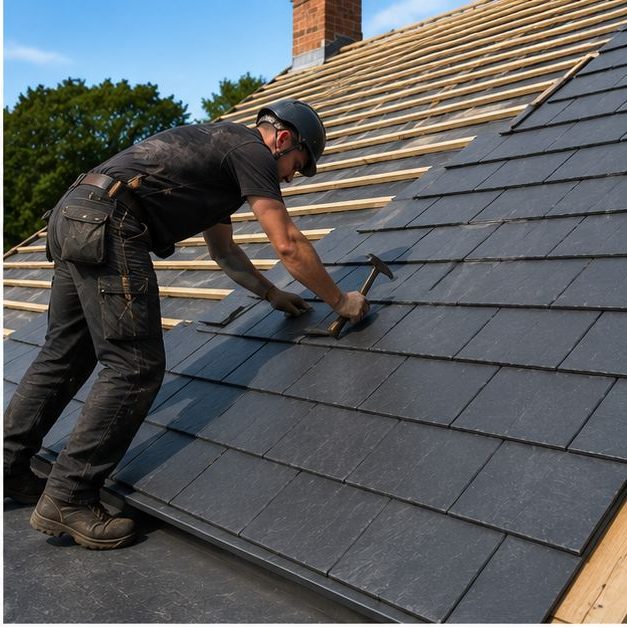
Hip tiles do a genuinely demanding job on any roof they are fitted to, arguably more so than the ridge itself in wet weather. Because they sit on a diagonal line running from the ridge down to the eaves, they are exposed to water running off two roof slopes at once, funnelled towards that single line rather than spread evenly across an open area of tiling the way rain falling on a flat expanse of roof generally is. They also tend to be more visible from the street than the ridge itself, since a hip runs down towards eye level rather than sitting at the very top of the roof out of easy sight from below.
During a full re-roof, the old hip tiles are removed along with the rest of the covering, and the hip rafter and any boarding beneath is checked and repaired if needed before new tiles go back on top. This is important because hips are a common place for hidden timber decay to develop, given how much water concentrates along that line over the years compared with the surrounding tiled area further up the slope. A re-roof gives the chance to inspect and put right any deterioration that would otherwise remain hidden under a straightforward tile-for-tile hip repair that never looks beneath the surface at all.
New hip tiles are then fixed using a method suited to the roof, whether that is a traditional bedded arrangement or a mechanically fixed dry system similar to that used on the ridge itself. Dry-fixed hips are increasingly common on new roofs in Shirehampton because they offer the same resistance to wind uplift and long-term mortar failure that makes dry ridge systems worthwhile, and they keep the hip line looking neat and consistent for considerably longer than a mortar-bedded equivalent typically manages before needing attention again. The junction where a hip meets the ridge at the top of the roof also needs particular care, since three separate roof planes converge at that single point and any weakness there can allow water to track into the roof space more readily than almost anywhere else on the structure.
If your Shirehampton home has a hipped roof and you are planning a re-roof, it is worth asking specifically how the hips will be handled rather than assuming they are automatically covered under a general specification. Brunel Roofing Bristol will detail hip tile replacement clearly as part of any quote, so you know exactly what work is included.
Get a Free Quote for New Roof Installations in Shirehampton
Every roof is different — the fastest way to get an accurate answer is a quick chat with our team.