
If damp staining on your chimney breast seems to appear or worsen specifically after rain, that timing is actually a useful clue rather than a coincidence, and it is one Brentry homeowners should pay attention to rather than dismiss. Staining that tracks closely with wet weather almost always points to water getting into the chimney structure from outside, rather than a separate issue like rising damp or condensation unrelated to the stack itself.
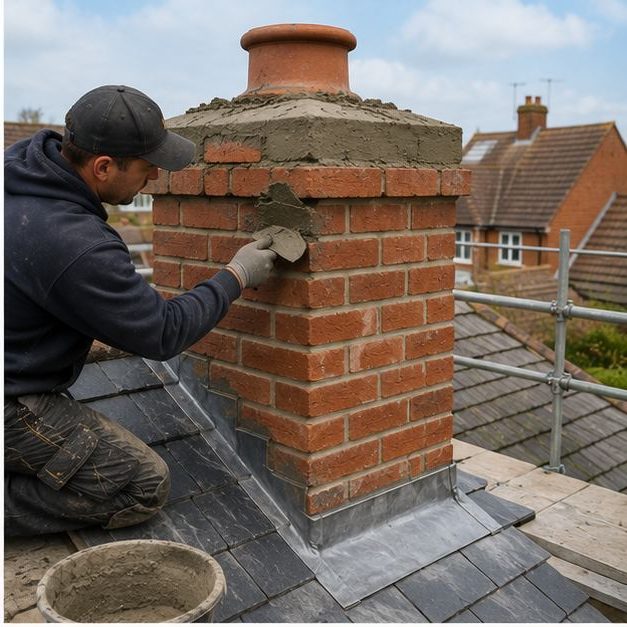
The most common culprit is failed lead flashing at the point where the chimney passes through the roof. This junction relies entirely on lead flashing and soakers to direct water around the stack rather than letting it track down into the roof structure, and once that lead has lifted, cracked, or corroded, rain finds a route in almost immediately during any reasonably heavy downpour. Because this water then has to travel through the building's structure before showing up as a visible stain, there is often a short delay between the rain starting and the staining appearing or spreading. Because this kind of fault often only becomes apparent under the pressure of genuinely heavy rain, a minor drizzle may produce no visible sign at all even where the flashing is already compromised.
Cracked flaunching at the top of the stack behaves similarly but affects the flue itself rather than the roof junction, letting rainwater track down inside the chimney around the base of the pot. This tends to produce staining that appears somewhat centrally on a chimney breast, often quite high up, whereas flashing failures more commonly show near where the chimney meets the ceiling or roofline.
Porous or spalling brickwork is a third, slower-acting cause. Rather than a single obvious entry point, sound-looking brick that has begun to crack and flake at the surface absorbs more rainwater than it should, and during a genuinely wet spell that moisture works through the wall thickness and appears as damp on the inside face. This tends to produce staining that develops more gradually over a period of sustained rain rather than appearing dramatically after a single downpour. The colour and pattern of the staining itself can offer a further clue, with a spreading, irregular patch more typical of brickwork absorption and a more defined line or edge more often associated with a specific flashing fault.
Because a leak indoors is not always directly below its actual source, tracing which of these is responsible usually needs a proper look at the stack, flashing and flaunching together rather than guesswork based on where the stain happens to sit. This is particularly true on Brentry's older properties, where more than one of these issues can be present at once, each contributing a little to the overall problem.
If you have noticed staining that tracks with rainfall, it is worth having the chimney assessed rather than simply redecorating over it. Brunel Roofing Bristol offers free inspections to trace the actual source across Brentry, with repairs backed by a 15-year guarantee.
Get a Free Quote for Chimney Repairs in Brentry
Every chimney is different — the fastest way to get an accurate answer is a quick chat with our team.