
On the larger Edwardian and interwar houses common in Henleaze, chimneys are often more architecturally complex than on smaller, later properties — sometimes with multiple roof pitches or valleys meeting close to the stack, which makes the lead flashing, soakers, and back gutter around it even more important to get right, and more involved to repair when they eventually fail after years of otherwise faithful service. Understanding this complexity in advance helps set realistic expectations for both the scope of a genuine repair and the time it's likely to take to complete properly on a taller, more detailed roofline.
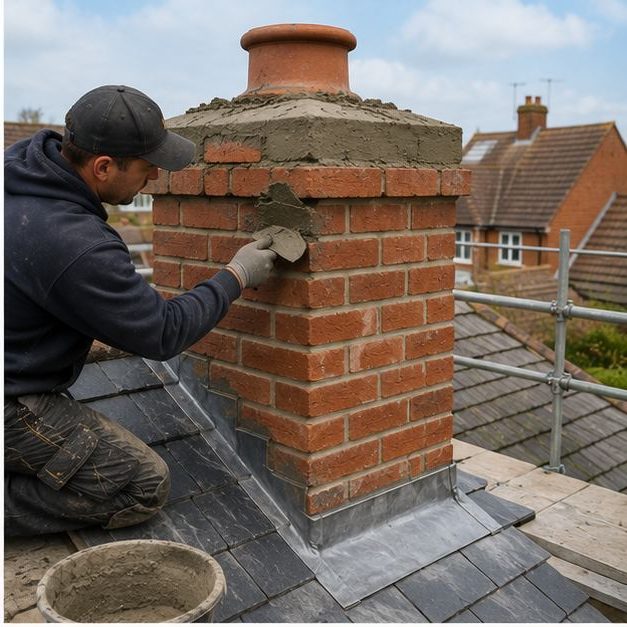
Soakers are the individual pieces of lead woven in between roof tiles at either side of a chimney, working alongside the main flashing to keep water from tracking in along the join. On a complex Henleaze roofline, where the stack might meet more than one pitch, there can be more soakers involved than on a simpler roof, and it's not unusual for a leak to trace back to just one that's shifted or corroded while the rest remain perfectly sound and intact around it.
As with flashing generally, failure tends to come from years of thermal movement fatiguing the lead until it cracks or lifts, sometimes compounded on older properties by the original lead simply reaching the end of a very long service life measured in decades rather than years of use. A leak that appears after rain from a particular direction, rather than in all weather, often points towards a specific soaker or section of flashing rather than a more general problem with the stack as a whole structure. Valleys running close to a chimney stack add a further layer of complexity, since water concentrated by the valley has to be safely directed away from the chimney junction rather than allowed to pool against it.
Repair work ranges from resealing and re-dressing lead that's still fundamentally sound, through to stripping out and replacing sections that have deteriorated too far to save economically for the homeowner. Given the complexity some of these period rooflines present, replacement work often needs individual soakers cut and dressed to fit the specific tile profile and pitch, rather than using a generic template that won't sit correctly against the existing roof covering.
Because of the height and complexity involved on many Henleaze properties, proper scaffold access is usually the sensible approach, both for safety and to allow a thorough check of the whole junction rather than just the section causing an obvious leak at the time the inspection is carried out. Older lead that's been patched informally over the years, perhaps using mastic or sealant rather than a proper lead repair, is often found during inspection and rarely holds up as well as a correctly dressed replacement.
If you've noticed a leak connected to your chimney on a Henleaze property, particularly one with a more complex roofline, Brunel Roofing Bristol can carry out a free inspection to identify the cause and recommend the right repair.
Get a Free Quote for Chimney Repairs in Henleaze
Every chimney is different — the fastest way to get an accurate answer is a quick chat with our team.