
Flashing failure is one of the most common reasons a roof in Lawrence Hill develops a leak that seems to come from nowhere, and the chimney is often where the trail leads. Lead is a durable material, but decades of thermal movement, weathering and, on some older properties, simply reaching the end of its practical working life all take their toll eventually, however well it was originally installed.
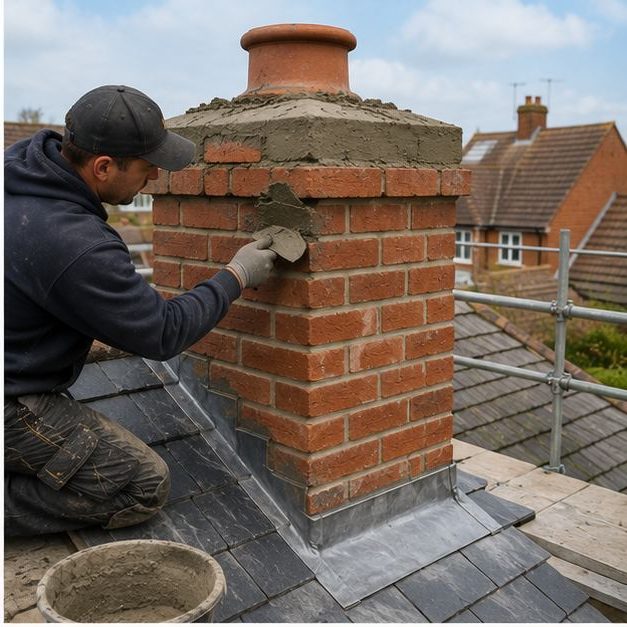
The main flashing seals the join between the chimney stack and the roof slope, but it isn't the only lead component involved. Soakers, individually dressed under each course of tiles or slates running up the sides of the stack, and a back gutter behind the chimney diverting water around the upslope side, both play just as important a role and are just as prone to failure, often without being visible unless the roof covering is disturbed or an inspection is carried out from inside the loft. Terraced properties with adjoining stacks add a further wrinkle, since the flashing detail where two chimneys meet can be more complex than on a stand-alone stack, and correspondingly more prone to developing a fault over time as materials age.
Signs of failing lead include visible cracking or splitting, edges that have lifted clear of the mortar joint they were dressed into, or a chalky white surface finish that shows the lead has become brittle. Indoors, staining on a chimney breast or ceiling nearby, particularly appearing after heavy rain rather than being constant, is usually the first indication something has gone wrong above, often noticed well before anyone thinks to check the stack itself for the actual underlying cause, sometimes over the course of an entire winter.
A leak's indoor appearance isn't always directly below the actual fault, since water can travel along roof timbers for some distance before finding a way through into the room below. Properly tracing the source, rather than patching the nearest visible gap, matters for a repair that actually lasts rather than one that needs revisiting the following winter once the same water finds its way back in.
Where the lead has failed in a single, localised spot, a targeted repair may suffice. Where it's uniformly aged across the whole stack, which is common on the older terraces found through Lawrence Hill, full replacement using Code 4 or Code 5 lead tends to be the more sensible long-term choice rather than repeatedly patching material that's simply reached the end of its life and will keep failing in new places regardless of how carefully it's patched.
If you've noticed a leak connected to your chimney, or can see cracked or lifted lead on the stack itself, it's worth having it inspected properly rather than assuming it will hold for another whole season of Bristol weather. Brunel Roofing Bristol repairs and replaces chimney leadwork across Lawrence Hill, backed by a 15-year guarantee on completed work.
Get a Free Quote for Chimney Repairs in Lawrence Hill
Every chimney is different — the fastest way to get an accurate answer is a quick chat with our team.