
Lead flashing does a deceptively difficult job. It sits at the awkward junction where a chimney stack passes through a sloped roof, bridging brick and tile in a way that has to flex slightly with temperature changes while staying completely watertight through years of Nailsea's wind and rain. When it fails, it is often one of the least visible problems on a roof and one of the most damaging, because water can be getting in for months before anyone notices a stain indoors, by which point timber and plaster may already be affected.
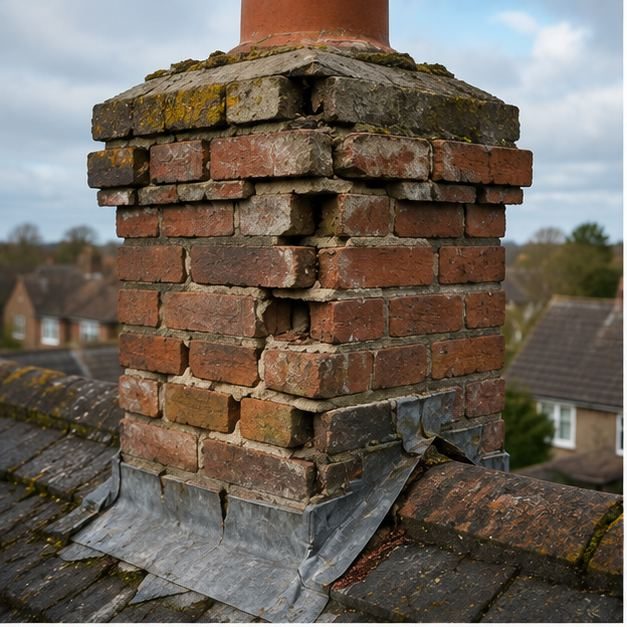
Flashing is generally made up of several parts working together: the main flashing pieces that dress down over the step of each roof tile, soakers tucked beneath the tiles at each course to carry water away, and often a back gutter positioned above the chimney to divert water around the stack rather than letting it pool against the brickwork. If any one of these fails, whether through age, poor original installation, or storm damage, water can find its way in even while the rest of the roof looks perfectly sound from the outside.
Older lead can crack from repeated expansion and contraction, or lift away from the brick as mortar in the flashing groove deteriorates and loses its grip. On properties in Nailsea with chimneys that have not been looked at in a long time, it is common to find flashing that was originally fitted well but has simply reached the end of its working life, particularly where cheaper flashing alternatives were used instead of proper lead in past repairs carried out by previous owners or contractors. Even flashing installed correctly the first time will eventually harden and lose the flexibility it needs to keep moving with the roof through seasonal temperature changes.
One of the trickier aspects of diagnosing a lead flashing problem is that the leak indoors is not always directly below where the water is actually getting in. Water can travel along a rafter or run down the inside of a chimney breast before it shows up as a damp patch on a ceiling some distance away, which is why a proper inspection traces the water back to its actual entry point rather than simply patching the area nearest the stain, which often solves nothing at all.
Repairing failed flashing usually means removing the damaged sections and re-dressing new lead into the joints, sometimes alongside repointing where the flashing groove itself has crumbled. It is not generally a job that can be done safely without scaffold access on anything but the simplest single-storey roof, since accuracy matters and lead needs to be dressed properly rather than forced into place in a hurry.
If you have noticed a damp patch near a chimney breast in your Nailsea home, or simply want peace of mind before winter, Brunel Roofing Bristol can inspect the flashing and let you know exactly what is needed, with a free quote and no pressure either way, and a 24-hour call-out available if the problem is urgent.
Get a Free Quote for Chimney Repairs in Nailsea
Every chimney is different — the fastest way to get an accurate answer is a quick chat with our team.