
Lead flashing rarely gets a second thought until water starts appearing somewhere it shouldn't, and for a lot of properties in Ridgeway that's exactly how a flashing problem first comes to light. The flashing's job is to seal the join between the chimney stack and the roof covering, and when it splits, lifts or corrodes, water can track down into the roof structure well before anyone notices anything wrong at the chimney itself. By the time a stain appears on a ceiling, the flashing has usually been letting water through for some time already.
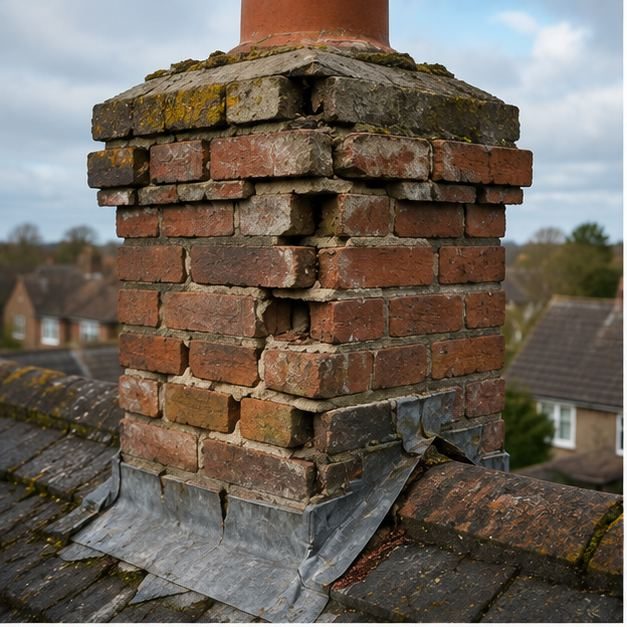
One of the trickier aspects of diagnosing flashing failure is that the leak indoors is not always directly below its source. Water can enter at the flashing, run along a rafter or the underside of the roof felt, and only show up as a stain on a ceiling or wall some distance away. This is why a competent inspection needs to trace the problem back to the chimney rather than simply patching the ceiling where the damp appears, since redecorating over a stain without fixing the flashing only guarantees the same mark returns after the next heavy rain.
Flashing can fail in a few different ways. Lead that has been mechanically fixed but not properly dressed into the brick joints can work loose over time as the roof and chimney move slightly with temperature changes. Soakers, the individual pieces of lead woven between roof tiles at the sides of the stack, can corrode or be dislodged in strong wind. And on older Ridgeway properties, flashing installed decades ago using a lighter grade of lead than would be specified today is often simply reaching the end of its working life, having done a reasonable job for far longer than it was ever really designed to. Wind-driven rain can also find its way under flashing that has lifted only slightly, which is why even a small amount of movement is worth investigating rather than dismissing as cosmetic.
Repairs range from re-dressing existing lead back into a cleaned-out mortar joint, to replacing sections of flashing or soakers entirely where the lead itself has thinned or split beyond repair. Because flashing sits at roof level, this is another job where safe access matters, and it's not something that should be attempted without the right equipment. On a two-storey terrace this typically means a tower rather than a ladder resting against the gutter line.
Left unaddressed, flashing failure tends to get worse gradually rather than dramatically, which makes it easy to underestimate until timber or plasterboard has already been damaged by prolonged, low-level water ingress that's been going on for longer than anyone realised.
If you've noticed a damp patch near a chimney breast, or simply haven't had your flashing checked in some years, Brunel Roofing Bristol can inspect it as part of a free quote for Ridgeway homeowners, with 24-hour emergency call-out available if the leak is causing immediate problems inside the property.
Get a Free Quote for Chimney Repairs in Ridgeway
Every chimney is different — the fastest way to get an accurate answer is a quick chat with our team.