
Ask any roofer where chimney leaks usually start and the honest answer, more often than not, is the lead flashing rather than the brickwork itself. In Warmley we see this pattern regularly — a leak gets blamed on the chimney generally, when the actual fault lies in flashing, soakers or a back gutter that's failed at the junction between the stack and the surrounding roof, an area that's easy to overlook when the brickwork above still looks perfectly sound. It's a pattern that catches a lot of homeowners out, since the brickwork above the flashing can look entirely sound while the actual fault sits just beneath it.
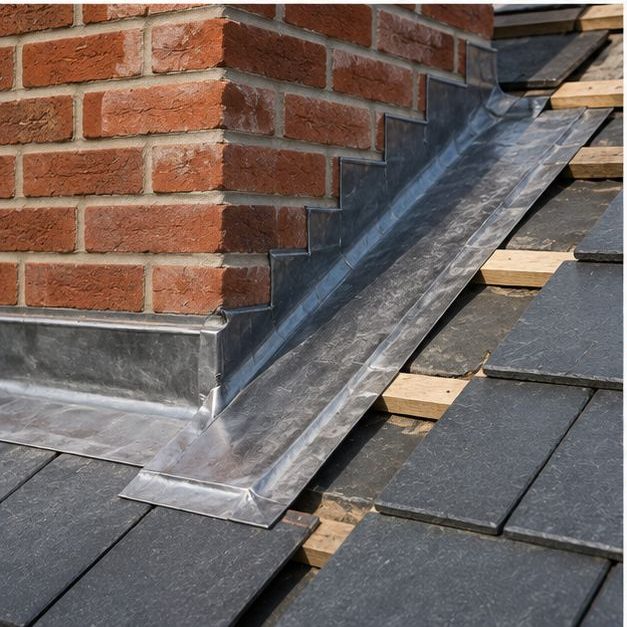
Flashing does a specific job: it seals the gap where the chimney passes through the roof covering, and it's made up of several components working together rather than a single sheet of lead. Step flashing runs along the sides of the stack, soakers sit beneath each individual tile or slate to guide water past the join, and a back gutter above the chimney channels rainwater running down the roof safely around rather than letting it pool against the brick.
Lead is a durable material, but it does age — it can corrode over decades, work loose from thermal movement, or simply have been installed poorly in the first place, all of which shorten its effective life. When flashing fails, water often tracks some distance before showing up as a damp patch indoors, which is why a leak near a chimney breast doesn't always point directly to where the actual defect is, and why a full check of the junction is worth doing rather than a spot repair alone. This is exactly why an inspection needs to look at the flashing itself rather than relying on symptoms alone to guess at the cause.
A back gutter that's undersized or has split is a particularly common culprit on wider stacks, since it's dealing with a larger volume of water running off the roof above. Properly assessing and, where needed, replacing these components with correctly dressed lead is usually more effective than repeated patch repairs with sealant, which tend to fail again within a season or two, leaving the same problem to resurface just as the weather turns again.
Where flashing has only recently started to show signs of wear, a targeted repair to the affected section can often be enough, rather than replacing the whole run of lead unnecessarily. The key is an inspection that assesses the condition of each component separately, rather than assuming the whole system needs to come out simply because one part has failed. Where replacement is genuinely needed, using correctly specified lead thickness for the size of the stack matters, since undersized lead is more prone to splitting and premature failure.
If you've got a leak connected to a chimney in Warmley, it's worth having the leadwork specifically checked rather than assuming the brickwork is at fault. Brunel Roofing Bristol repairs and replaces chimney flashing, soakers and back gutters across Warmley, backed by a 15-year guarantee, with 24-hour emergency call-out available for urgent leaks.
Get a Free Quote for Chimney Repairs in Warmley
Every chimney is different — the fastest way to get an accurate answer is a quick chat with our team.