
Wherever a chimney passes through a roof, there is a junction that has to cope with two different surfaces moving and weathering independently, and it is one of the most common places on any property for a leak to start. It is a junction that has to work reliably in all weather, year after year, without any regular attention — which is exactly why it eventually needs a proper repair rather than being left to look after itself indefinitely. Getting that junction right relies almost entirely on the lead flashing dressed around the base of the stack.
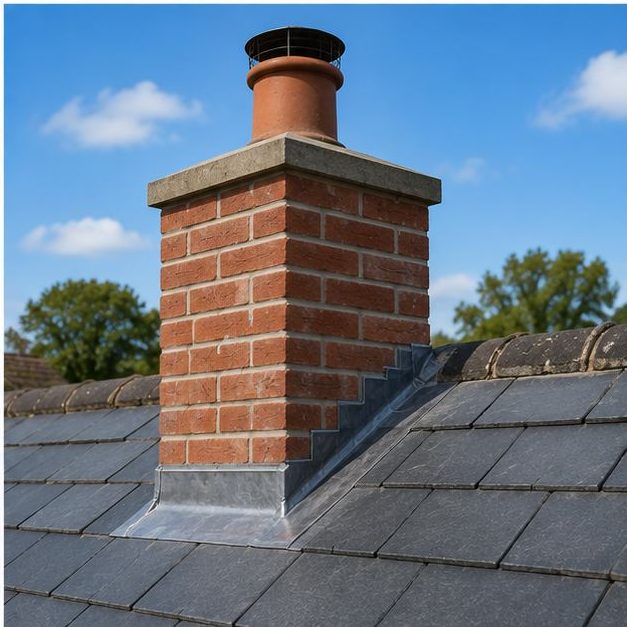
The flashing itself is made up of a few distinct elements. An apron or step flashing covers the visible joint along the front and sides of the chimney, soakers are tucked individually beneath each row of tiles or slates to guide water past the joints one course at a time, and a back gutter, where the chimney sits partway up a roof slope, catches the larger flow of water running down from above the stack and redirects it around rather than letting it pool against the brickwork. Each of these pieces is doing a specific job, and a weakness in just one of them is often enough to let water through even when everything else is sound.
Leaks at this junction develop for a fairly predictable set of reasons: the lead lifting at an edge after years of thermal movement, the mortar joint it was dressed into eroding and letting the flashing pull loose, or — quite commonly on older repairs — someone having patched a previous problem with sealant rather than proper leadwork, which then perishes and fails again after a season or two, often leaving the homeowner assuming the leak had been fixed until the next heavy downpour proves otherwise.
A proper repair means re-dressing the existing lead where it is still sound, or stripping out and replacing sections that have degraded beyond a reasonable repair, then re-securing everything into a freshly cut mortar joint. It is not a job that lends itself to shortcuts — a flashing repair that looks fine from the ground but has not actually been dressed and sealed correctly tends to fail again within a year or two, which ends up costing more overall than doing it properly the first time.
Junction leaks are also notoriously tricky to trace from indoors, since water entering at the flashing can travel along a rafter before showing up as a stain some distance from the actual chimney. A proper inspection from up at the stack, rather than guesswork from inside the loft, is usually needed to pin down the exact point of failure.
If you have a leak near a chimney breast on a Filton property, Brunel Roofing Bristol can trace it back to the source and carry out proper leadwork repairs rather than a temporary patch — contact us for a free inspection.
Get a Free Quote for Chimney Repairs in Filton
Every chimney is different — the fastest way to get an accurate answer is a quick chat with our team.