
Lead flashing does most of the real work of keeping water out where a chimney meets the roof, and on Redcliffe's older terraces, where stacks are often original to the building, that leadwork can be well past its best without anyone realising until a leak actually appears indoors. It is one of the more overlooked parts of a chimney precisely because it sits tucked against the brickwork rather than being an obvious feature of the roof.
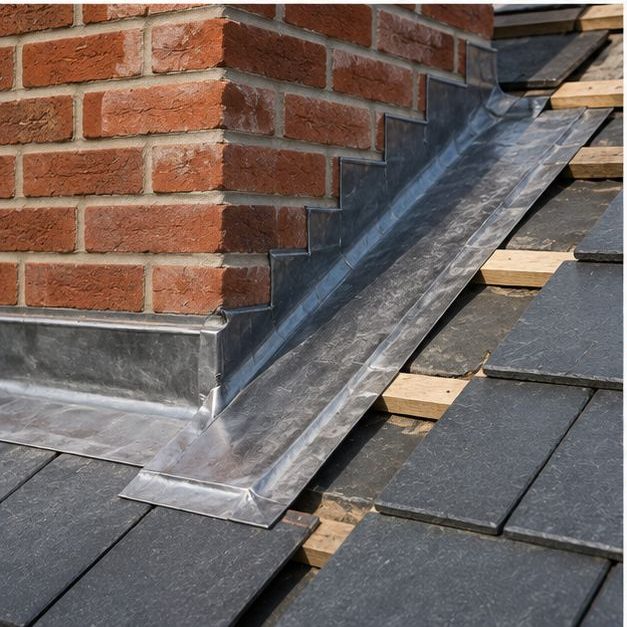
Failure tends to happen gradually: lead cracking with age and repeated thermal expansion and contraction, edges lifting away from the brick joints they were originally dressed into, or the metal simply being disturbed by birds, squirrels, or general weathering over decades. On stepped or complex rooflines common across Redcliffe's terraced housing, the soakers woven between tiles at the sides of a stack and the back gutter that diverts water around the uphill side of the chimney are just as likely to fail as the main flashing itself, and are often harder to spot from the ground. Poorly executed past repairs, using unsuitable materials such as mastic or flashing tape as a quick fix, are also a common contributing factor found during inspections of older stacks.
This is a large part of why leaks near a chimney breast can be so difficult to pin down without a proper inspection — water entering at a failed flashing point can travel along roof timbers or down the inside of a chimney breast before it shows itself as a damp patch, sometimes at a noticeable distance from the actual point of ingress. Anyone in Redcliffe dealing with an intermittent leak, particularly one that seems worse when wind is driving rain from a specific direction, should have the chimney's leadwork checked as a priority.
Repairs range from re-dressing and re-pointing lead that has simply lifted, through to full replacement of flashing, soakers and back gutter using correctly specified lead — usually Code 4 or Code 5 depending on exposure — where the original material has genuinely reached the end of its serviceable life or was poorly installed in a previous repair. A proper inspection should make clear fairly quickly which category a given stack falls into.
Given the height of most Redcliffe terraces, this work needs proper scaffold access to be done safely and thoroughly, which makes it sensible to have leadwork checked whenever other roof or chimney access is already arranged, rather than treating it as a separate job each time.
If you've noticed a leak that seems to originate somewhere near a chimney breast in your Redcliffe home, Brunel Roofing Bristol can trace the actual source rather than guessing, saving you from paying for repairs that were never going to fix the real problem, with free inspections, a 15-year guarantee on completed work, and 24-hour emergency call-out for anything urgent.
Get a Free Quote for Chimney Repairs in Redcliffe
Every chimney is different — the fastest way to get an accurate answer is a quick chat with our team.