
It is tempting to treat chimney pointing and chimney leadwork as two entirely separate jobs, and sometimes they genuinely are, but for Bromley Heath properties there is a good practical reason to have both checked together whenever one is being assessed. They protect different parts of the same structure, mortar joints across the brickwork and the flashing where the stack meets the roof, but a fault in one can mask, or be mistaken for, a fault in the other.
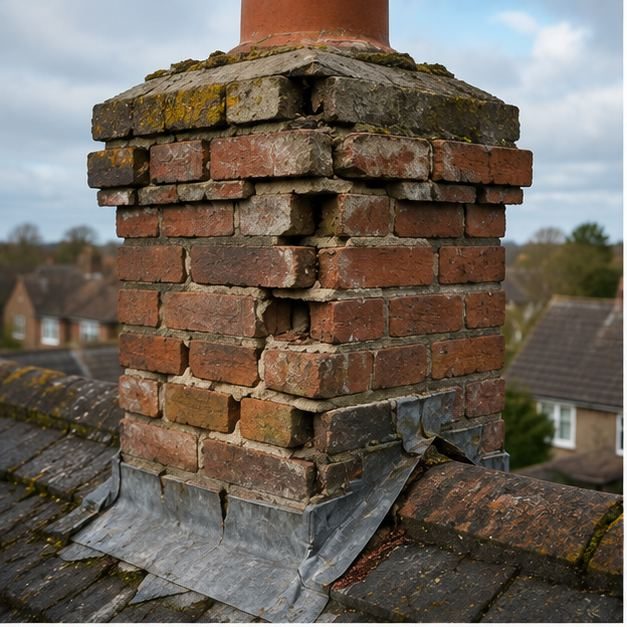
Water ingress from a chimney does not always announce clearly whether it is coming from failed pointing or failed flashing, particularly once it has already tracked some distance through the structure before appearing as a stain indoors. Damp on a chimney breast can equally originate from mortar joints that have eroded enough to let rain into the brick, or from lead flashing that has lifted or cracked at the roofline, and distinguishing between the two from an internal stain alone is genuinely difficult without a proper look at both from outside. This is part of why a homeowner reporting a leak is sometimes unable to say with confidence whether the issue is new or has been developing quietly for a considerable time before finally becoming visible indoors.
Access is a second, more practical reason to check both together. Reaching a chimney safely, whether by tower scaffold or full scaffolding, is often the larger part of the cost of any chimney work, and once that access is arranged it makes little sense to inspect only the pointing and ignore the flashing, or vice versa, when both can be assessed for a marginal amount of extra time while already at height.
The two also interact physically in ways worth understanding. Deteriorating mortar joints near the base of a stack can allow water to work its way behind flashing that is otherwise sound, effectively undermining good leadwork from a different direction. Equally, failed flashing that allows water to sit against the base of the brickwork for longer than it should can accelerate mortar erosion in that specific area, meaning a leadwork fault left unaddressed can bring forward the need for repointing sooner than it would otherwise have been required. A joined-up assessment also allows repairs to be sequenced sensibly, addressing whichever fault is actively causing the greater ongoing damage first, rather than treating both as equally urgent regardless of their actual condition.
For Bromley Heath's mix of housing ages, this combined check matters whether the property is older, with traditional lime mortar and long-serving lead, or more recent, where cement mortar and modern flashing materials are more common but still subject to gradual wear over time.
If you are having chimney repointing considered for your Bromley Heath property, it is worth asking for the surrounding leadwork to be checked at the same time. Brunel Roofing Bristol assesses both as standard during a free inspection, with all repairs backed by a 15-year guarantee.
Get a Free Quote for Chimney Repairs in Bromley Heath
Every chimney is different — the fastest way to get an accurate answer is a quick chat with our team.