
Semi-detached properties sit in a middle ground for chimney repair work, generally offering easier access than a terraced home while still bringing a few considerations that differ from a fully detached house, and Brislington has a substantial amount of semi-detached housing where these details are worth understanding before repair work begins. Where two semi-detached properties have historically maintained their respective chimneys to different standards, it is not unusual for one side of a shared roofline to need considerably more attention than the other.
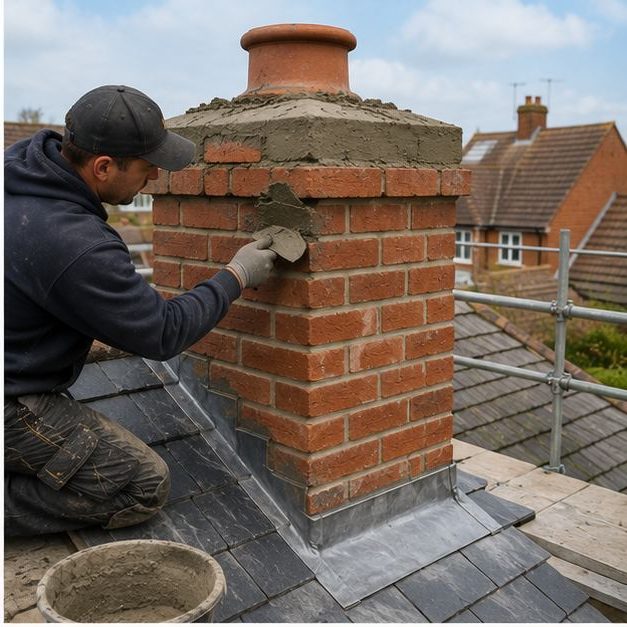
Access is usually more straightforward than on a terrace, since most semi-detached properties have at least a side passage or driveway on one side, even if the other side is shared with, or close to, the neighbouring property. This generally makes scaffolding somewhat easier and less costly to erect than on a terraced home with no side access at all, though it is rarely as simple as a fully detached property with clear ground on every side. Where a driveway or side passage is available, it is worth confirming in advance whether it will remain usable during the work, since scaffolding and material storage can temporarily restrict access for vehicles.
Shared chimney stacks are less common on semi-detached properties than on terraces, but they do still occur, particularly on older semi-detached housing built with a party wall running centrally through a shared chimney breast. Where this applies, the same consideration around neighbouring access and, occasionally, coordination applies as it would for terraced properties, even though semi-detached homes are more often built with entirely separate stacks for each half. Where a chimney breast has been removed internally on one side of a semi-detached pair at some point in the past, this can occasionally affect the structural support available to the remaining external stack, and is worth flagging during any assessment.
The age and construction of semi-detached housing in Brislington varies more than terraces typically do, spanning everything from older Victorian-era semis with traditional lime-mortared brick chimneys through to considerably more modern semi-detached estates with simpler, less exposed stacks. This affects the appropriate mortar, the likely scope of repair, and how much of the chimney is genuinely load-bearing structure versus a more straightforward decorative or flue-carrying stack on newer builds. Roof extensions built onto semi-detached properties sometimes bring a chimney closer to a new valley or junction than it originally sat, which is worth factoring into any leadwork assessment carried out alongside the main repair.
Because semi-detached roofs often have a slightly more complex roofline than a simple terrace, particularly where an extension or dormer has been added over the years, it is also worth having the chimney's flashing and surrounding roof covering checked together, since additions to a property sometimes alter water flow around a chimney in ways that were not fully accounted for when the extension was built.
If you own a semi-detached property in Brislington and want an honest view of what your chimney needs, Brunel Roofing Bristol offers free inspections and quotes covering both the chimney and its surrounding roof detail, with all repairs backed by a 15-year guarantee.
Get a Free Quote for Chimney Repairs in Brislington
Every chimney is different — the fastest way to get an accurate answer is a quick chat with our team.