
Some of the most important lead detailing on a roof is also the smallest and least visible, and soakers are a good example. Fitted individually under each course of tiles or slates where they meet a chimney, they're barely noticeable once installed correctly, yet they're doing continuous work to keep water out at one of the most vulnerable junctions on the roof.
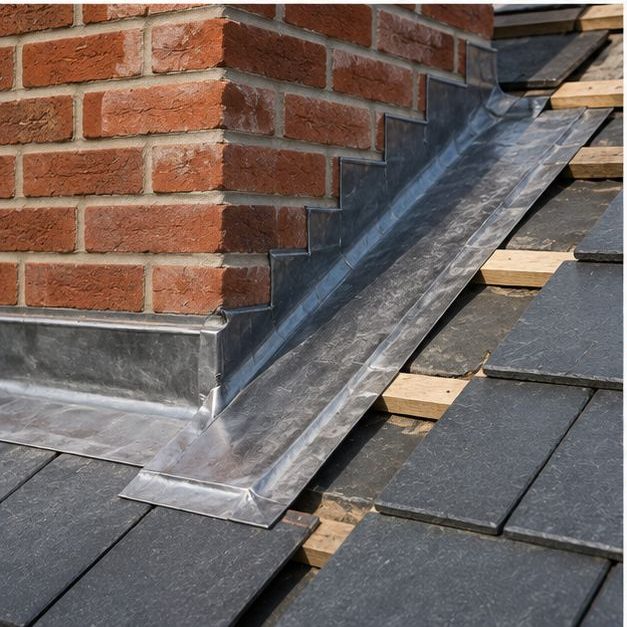
Each soaker is a small, individually shaped piece of lead, overlapped with the tile or slate above and tucked beneath the one below, forming a stepped, weatherproof seal running down the length of the chimney where it meets the roof slope. Unlike the main flashing, which covers the join in one continuous run, soakers handle water at every individual course, which means a single failed soaker can create a leak at exactly one point along an otherwise sound run of flashing.
Soakers tend to fail through corrosion, physical disturbance during other roof work, or simply age, and because each one is small and hidden beneath the roof covering, a failed soaker often isn't obvious until water starts tracking through at that specific point. This can make diagnosis trickier than a more visible flashing failure, since the leak might only show up under particular wind directions that drive rain against that exact section of the stack.
On the pitched, tiled and slated roofs common across Bishopston, where many chimneys run through the main roof slope rather than sitting at a gable end, soakers are doing a lot of quiet, unglamorous work, and it's an area worth checking specifically if a leak has proved difficult to trace through other means.
It's worth reassuring anyone who's put off a soaker repair assuming it means a major re-roof: fixing a small number of individual soakers is generally a contained, targeted job rather than something that disrupts the whole roof covering, provided it's caught before the surrounding area has suffered wider water damage. Because accessing soakers means disturbing the roof covering either way, it's common for soaker repairs to be carried out alongside a wider flashing repair or as part of a re-roof, rather than as an isolated job. If the main flashing is already being renewed, checking the soakers at the same time is a sensible, low-cost addition rather than a separate project. Because each soaker only protects a single course of roofing material, a chimney with a long run alongside the roof slope will have a correspondingly large number of them, and it's not unusual for just one or two out of many to be the actual point of failure, which is part of why a careful, methodical check matters more than a quick glance.
Repairing soakers usually means carefully lifting the surrounding tiles or slates to access and replace the affected lead individually, then reinstating the roof covering so the repair is invisible once finished. If you've got a chimney leak that hasn't responded to more obvious fixes, we're happy to check the soakers as part of a free inspection across Bishopston.
Get a Free Quote for Chimney Repairs in Bishopston
Every chimney is different — the fastest way to get an accurate answer is a quick chat with our team.