
Wind-driven rain behaves quite differently from an ordinary vertical downpour, and it is a particular challenge for chimneys on properties in Portishead, where wind off the estuary regularly pushes rain into a stack at an angle rather than letting it simply run down the face of the brickwork as it would on a calmer day. Understanding how this affects a chimney helps explain why some repairs that would be entirely adequate on a sheltered inland property fall short here. It is not that the workmanship is necessarily worse, simply that the conditions being defended against are genuinely more demanding.
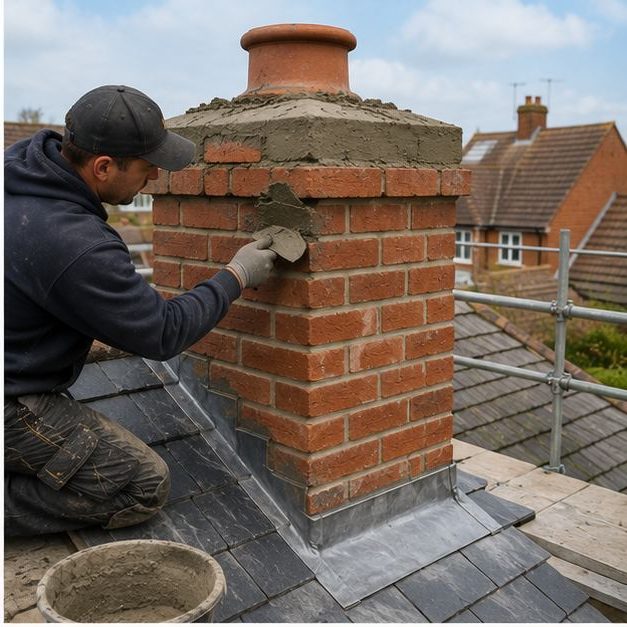
The lead flashing around a chimney is one of the first lines of defence, and it needs to be properly dressed and sealed rather than merely adequate, since angled rain can find its way into gaps that would stay dry under calmer conditions elsewhere. Soakers beneath each course of roof tile, and a back gutter above the stack where relevant, both play a part in channelling water away rather than letting it pool or force its way sideways into the roof structure below. Getting the detailing right at this stage is far cheaper than dealing with the consequences of a poor original installation years later.
Mortar joints matter just as much. Recessed or crumbling pointing gives wind-driven rain somewhere to push into that it would not otherwise find, so keeping joints properly maintained is a more meaningful preventative measure in a windy coastal setting than it might be elsewhere further from the water. Choosing a mortar mix appropriate to the property, lime-based for older, softer brick and cement-based for modern brick, also affects how well the stack sheds water it does absorb over time, another reason a like-for-like repair matters more here than it might in a calmer setting.
The flaunching at the top of the stack deserves particular attention too, since it is the first surface wind-driven rain meets and needs to be sloped correctly and kept crack-free to shed water away from the pots rather than letting it seep down around their base and into the stack. A cowl fitted over an open pot can also help by reducing how much rain reaches the flue opening directly, particularly useful on exposed roofs where rain rarely falls straight down for long during a genuine storm.
None of these measures work in isolation, and the most effective protection against wind-driven rain generally comes from a chimney where flashing, flaunching, mortar, and pots are all in good condition together, rather than one element being excellent while another is neglected and lets water in regardless of the rest.
If your chimney in Portishead has let water in during a recent storm, or you would simply like it checked before the next one arrives, Brunel Roofing Bristol offers free inspections and a 24-hour emergency call-out service for anything that needs urgent attention, with completed repairs covered by a 15-year guarantee.
Get a Free Quote for Chimney Repairs in Portishead
Every chimney is different — the fastest way to get an accurate answer is a quick chat with our team.