
Lead flashing is used across a number of junctions on a typical roof, wherever a simple tile or slate covering cannot form a reliable seal on its own: around chimneys, along abutments where a roof meets a wall, and at valleys where two roof slopes join. On properties across Frenchay, lead flashing failure is a fairly regular cause of emergency call-outs after storms, given how many of these junctions a typical roof has, particularly on older properties with more complex roof shapes.
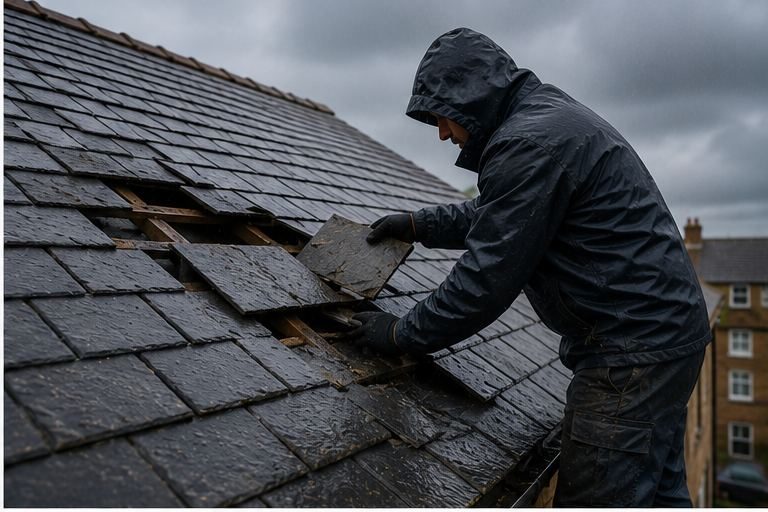
Lead is chosen for this role because it is durable and can be dressed closely to irregular shapes, but it still relies on a continuous, well-formed seal to actually keep water out. High winds can work at the edges of a flashing strip over time, and while a single storm rarely causes this kind of damage from nothing, it very often provides the final push that lifts a flashing section that had already been gradually weakening for months or years beforehand.
Once flashing has failed, water can get in surprisingly quietly. Rather than a dramatic leak appearing immediately, it is common for water to track along roof timbers or down inside a wall cavity for some time before showing as a damp patch or stain indoors, meaning the visible sign of the problem is sometimes some distance from the actual point of failure, which is why tracing it accurately usually needs a proper roof inspection rather than guesswork.
An emergency repair focuses first on stopping this water ingress, either by re-dressing lead that remains sound back into its correct position, or fitting a temporary seal where a full replacement will need to be scheduled separately. Getting the roof weathertight quickly limits how much further damage occurs to timber and insulation while the permanent repair is arranged, particularly if further wet weather is forecast in the days ahead.
The permanent repair typically means replacing the affected flashing entirely with new lead, correctly formed and dressed against the surrounding brickwork or roof junction, along with checking and resetting any tiles or slates disturbed in the process. Where access is needed at height, for instance around a chimney on one of Frenchay's taller properties, scaffolding is sometimes the safest way to carry out the work properly, giving the roofer secure and unhurried access to complete the job to a proper standard rather than working awkwardly and less safely from a ladder propped against the building.
If lead flashing on your Frenchay property has failed after a recent storm, Brunel Roofing Bristol offers a 24-hour emergency call-out to make the roof safe, followed by a permanent repair backed by our 15-year guarantee on completed work, giving you lasting confidence in the job long after our team has left.
Need Emergency Roof Repairs in Frenchay?
Every case is different — the fastest way to get an accurate answer is a quick chat with our team.