
Lead has been used in roofing for centuries because it is durable and flexible enough to be dressed around awkward junctions, but it does not last forever, and many of Montpelier's period properties still have leadwork that predates any of the recent roof coverings above it. Chimney flashing, valley linings, and parapet details all rely on lead staying properly seated and free of splits, and a storm is often what finally exposes leadwork that has quietly been deteriorating for years, sometimes for far longer than any single occupant of the property would have been aware of.
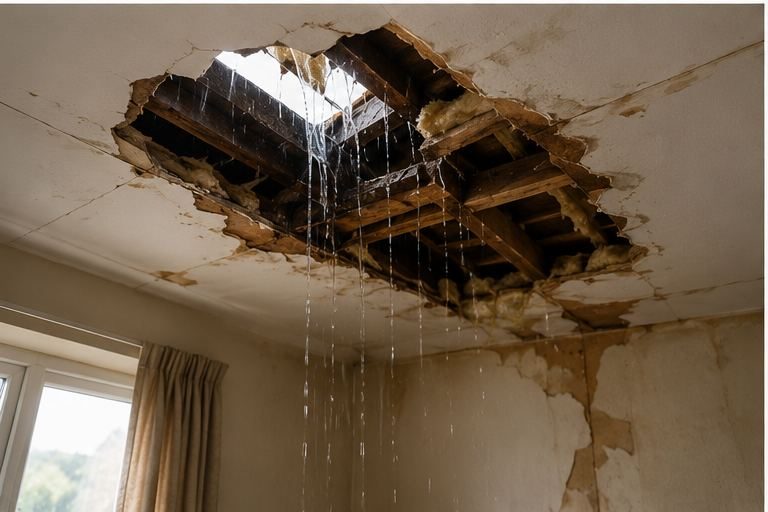
Wind can lift the edges of flashing that has come slightly loose, tear at joints that have started to fatigue, or dislodge sections that were already thinning through age-related lead fatigue, a natural process where repeated expansion and contraction over decades causes fine cracks to develop. Once a crack or lifted edge appears, water finds its way in surprisingly easily, often travelling some distance before it shows up as a stain inside the property.
Because leadwork sits at so many critical junctions on a period roof, from chimney stacks to valleys where two roof slopes meet, a failure here can affect a disproportionately large area compared with its size. A few inches of split flashing around a chimney, for instance, can be enough to let water track down into a chimney breast and affect a room some distance below the actual point of entry.
Parapet walls, found on some of Montpelier's flatter-fronted terraces, bring their own leadwork detail in the form of parapet gutters and cover flashings, which sit somewhat hidden from view behind the wall itself. These details are easy to overlook during a general inspection from the street but are just as prone to storm-related failure as more visible chimney or valley leadwork, which is why we check them specifically on properties where this type of roof detail is present. A leak from a failed parapet gutter can travel a considerable distance inside the wall structure before showing itself, so tracing the true source properly at roof level saves a good deal of guesswork lower down.
Repairing leadwork properly means more than just resealing a gap with mastic, which tends to fail again within a season or two. Our approach is to assess whether the existing lead can be refitted and made sound, or whether the affected section has degraded enough to warrant replacement with new leadwork dressed correctly around the relevant junction, giving a repair that should last for years rather than months.
If you suspect a leadwork failure on a Montpelier property, perhaps a leak that appeared during or shortly after a storm, it is worth having it assessed by someone experienced with period roofs rather than a generic patch repair. We offer free inspections across Montpelier, and completed leadwork repairs are covered by our 15-year guarantee, reflecting our confidence in the standard of work carried out.
Need Emergency Roof Repairs in Montpelier?
Every case is different — the fastest way to get an accurate answer is a quick chat with our team.