
Felt and rubber flat roofs cope with storms differently to a tiled pitched roof, and it's worth understanding that difference if your Lockleaze property, or an extension or garage attached to it, has one. Rather than shedding water down a slope, a flat roof depends on a continuous, unbroken waterproof surface, and that surface is exactly what a storm tends to target.
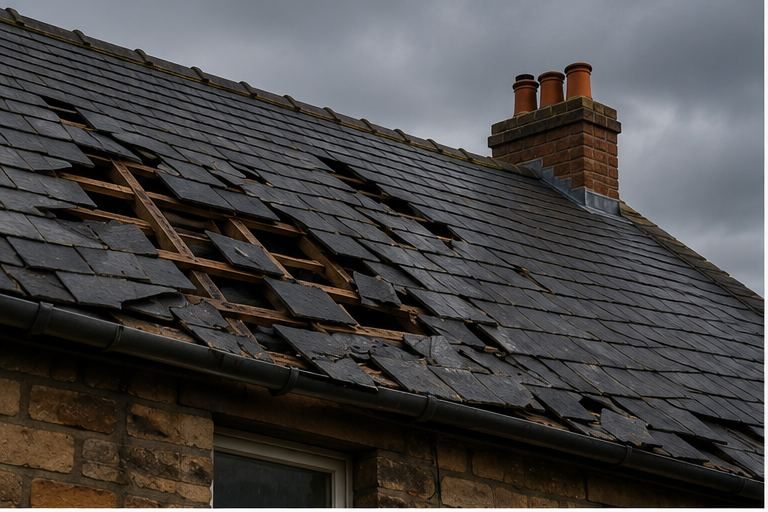
High winds can get underneath the edges of felt or rubber roofing and lift it, work at joints and upstands around the perimeter, or in more severe cases tear the covering outright, particularly where it's aged and lost some of its original flexibility. Once a split or tear appears, rain has a direct way in, and because water doesn't drain off a flat roof as quickly as a pitched one, it can sit and worsen the damage before anyone notices from inside the property.
Storm damage to a flat roof isn't always as visually obvious as a missing tile would be on a pitched roof. Signs worth looking out for include bubbling or blistering across the surface, a patch that looks noticeably darker or more saturated after rain than the rest of the covering, and, indoors, a damp patch on the ceiling directly below the flat roof area.
An emergency repair generally starts with locating exactly where the covering has failed, since the point where a leak shows up indoors isn't always directly below the actual damage on a flat roof, water can travel sideways under the covering before finding a gap in the ceiling to come through. Temporary weatherproofing may be used to prevent further ingress while a permanent repair, or in some cases a full recovering, is arranged.
The age and type of flat roof covering also affects how well it copes with a storm in the first place. Older bitumen felt systems generally have a shorter working life and can become brittle over time, making them more prone to splitting under wind stress, while newer single-ply or rubber coverings tend to offer somewhat better resistance, though neither is entirely immune to damage in a genuinely severe storm. If your Lockleaze property's flat roof is approaching the end of its expected lifespan, a storm can sometimes be the trigger that reveals it's more cost-effective to plan a full recovering than to keep patching an ageing covering that's likely to keep failing in future weather. Upstands, the raised edges where a flat roof meets a wall or parapet, are another area worth checking specifically, since these junctions are common failure points distinct from the main flat expanse of the roof itself. A tear or gap at an upstand can let water in behind the covering in a way that's sometimes harder to spot than damage across the open, flat section, making it an area worth asking your roofer to check carefully during any flat roof inspection.
If storm damage has affected a flat roof on your Lockleaze property, Brunel Roofing Bristol offers free inspections and a 24-hour emergency call-out, with completed flat roof repairs covered by a 15-year guarantee.
Need Emergency Roof Repairs in Lockleaze?
Every case is different — the fastest way to get an accurate answer is a quick chat with our team.