
Flashing rarely gets a second thought until it fails, and when it does, the resulting leak can seem to come from nowhere, since the flashing itself isn't always visible from the ground. For properties in Ashley Down, understanding why this thin strip of material causes such disproportionate trouble helps explain why it's such a common source of post-storm and heavy-rain leaks, even on roofs where the tiles or slates themselves are in good condition.
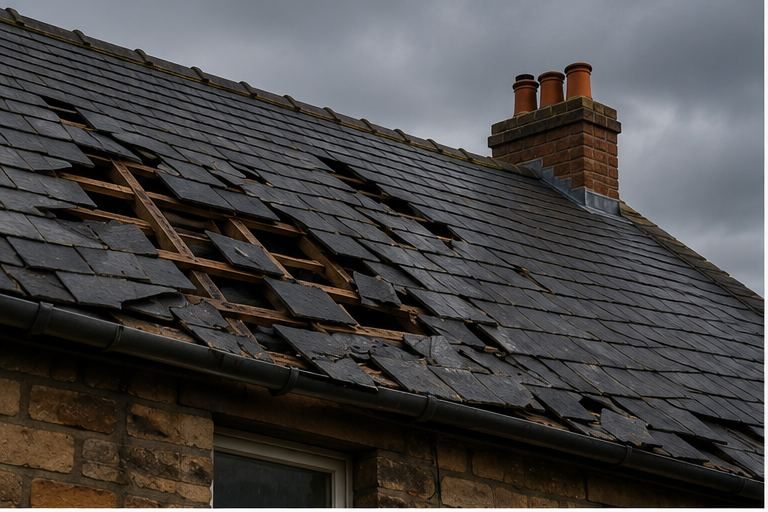
Flashing, usually made of lead, is fitted at the joins where a roof meets something else: around chimneys, in valleys where two roof slopes meet, along abutments where a roof meets a wall, and around roof windows. These are naturally the weakest points in a roof's weatherproofing, since they can't rely on the simple overlapping-tile principle that keeps water out across the rest of the roof, and instead depend entirely on the flashing being correctly fitted and undamaged. Even a small tear or a poorly sealed join in the lead can be enough to let water through during a heavy downpour.
Storms and high winds can lift, crease, or partially detach flashing, and even movement that looks minor from the ground can be enough to open a gap. Once that happens, heavy rain, particularly driving rain during a storm, will find its way through far more readily than in dry, still conditions, which is why a flashing problem sometimes only becomes obvious during the next spell of really heavy weather rather than immediately after the storm that caused it in the first place. Wind direction plays a part too, since flashing that's held firm against gusts from one direction can still be vulnerable to rain driven in from another.
This delay is part of what makes flashing damage tricky: a leak might not appear the same day the flashing was disturbed, and when it does appear, the water can travel along rafters or felt before showing up as a stain on a ceiling some distance from the actual flashing that failed. This is why an inspection focused specifically on flashing, rather than just a general glance at the tiles, is often needed to properly diagnose the cause of a leak that seems otherwise unexplained. This is one of the more common reasons a leak can seem to defy explanation at first glance.
Because most flashing on Ashley Down properties is fitted around chimneys, which usually means working at height and often needing safe access equipment, this isn't a repair that should be attempted without the right training. A roofer will typically re-dress or replace the damaged section of lead, checking the surrounding tiles and mortar joints at the same time to make sure nothing else has been overlooked.
If heavy rain has brought on a leak that seems to have appeared out of nowhere, damaged flashing is worth ruling in or out early. Brunel Roofing Bristol offers free inspections across Ashley Down and can carry out flashing repairs backed by a 15-year guarantee.
Need Emergency Roof Repairs in Ashley Down?
Every case is different — the fastest way to get an accurate answer is a quick chat with our team.