
Lead flashing rarely gets much thought until it fails, but it does one of the most important jobs on any roof: sealing the junctions where two different surfaces meet — chimney to tile, wall to roof, dormer to slope — and keeping water out of what would otherwise be a series of vulnerable gaps. On properties across Pucklechurch, it's usually storm-force wind rather than age alone that finally causes flashing to fail, lifting an edge that had been holding on quietly for years without drawing any attention at all.
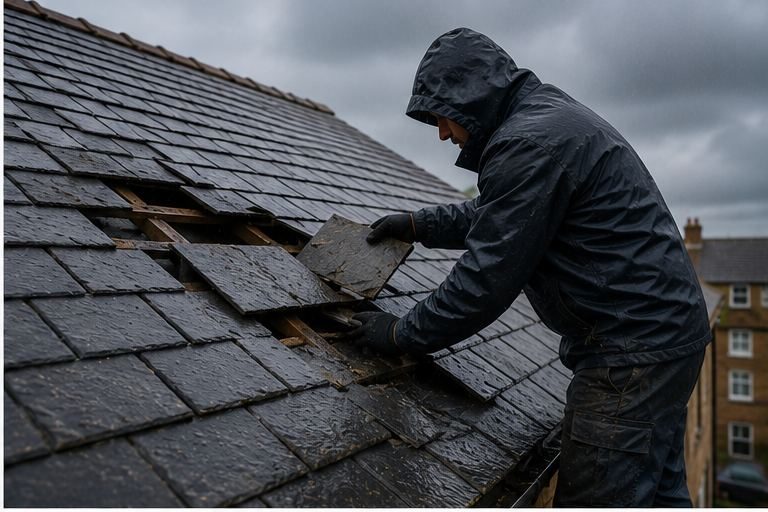
Wind damage to flashing on a roof like this tends to happen in one of a small number of characteristic ways. It can be physically lifted or torn away from its fixing, particularly if the mortar or pointing holding it in place has already started to deteriorate. It can also simply be worked loose gradually, with repeated flexing during gusty conditions eventually breaking the seal even without a single dramatic tear. Either way, the result is the same: a gap opens up at a junction that's meant to be completely watertight. Older flashing that has already been patched once before tends to be at somewhat greater risk, since a previous repair isn't always quite as robust as the original detailing.
Because flashing sits at these junction points rather than across open roof slopes, damage here tends to cause leaks that are disproportionately serious relative to how genuinely small the actual gap might be. Water can track in steadily during every subsequent spell of rain, often running along roof timbers before showing up as a damp patch some distance away — around a chimney breast, along a ceiling edge, or near a dormer window — rather than directly beneath the fault itself.
Repairing damaged flashing properly means more than just pushing a lifted edge back into place. It usually involves removing and refitting a section, sometimes rebuilding the pointing or mortar that anchors it, and checking that the surrounding tiles or slates haven't also been disturbed by the same storm. Done properly, a lead flashing repair should last for many years without further attention.
Because flashing problems can be subtle from ground level — a small lifted edge isn't always visible without getting close to the roof — it's worth having any suspected storm damage checked rather than assuming everything is fine simply because there's no obvious leak yet. This is especially true after a storm severe enough to have caused other visible damage nearby, since flashing failures often coincide with tile or ridge damage from the same event.
Brunel Roofing Bristol repairs storm-damaged lead flashing across Pucklechurch, with free inspections to assess the damage and a 15-year guarantee on all completed repair work. We'll always explain exactly which junctions have been affected and why, so you have a clear picture of what's been done and why it should now hold firm and stay watertight for years.
Need Emergency Roof Repairs in Pucklechurch?
Every case is different — the fastest way to get an accurate answer is a quick chat with our team.