
Ridge tiles, running along the very top of a roof, and hip tiles, covering the sloped edges where two roof sections meet, both play a genuinely important role in keeping a roof watertight, capping the joins where a straightforward tile or slate covering alone would not be enough. On Downend properties, these tiles are traditionally bedded in mortar, a method that has served roofs well for generations but that does have a finite lifespan, particularly when tested by storms.
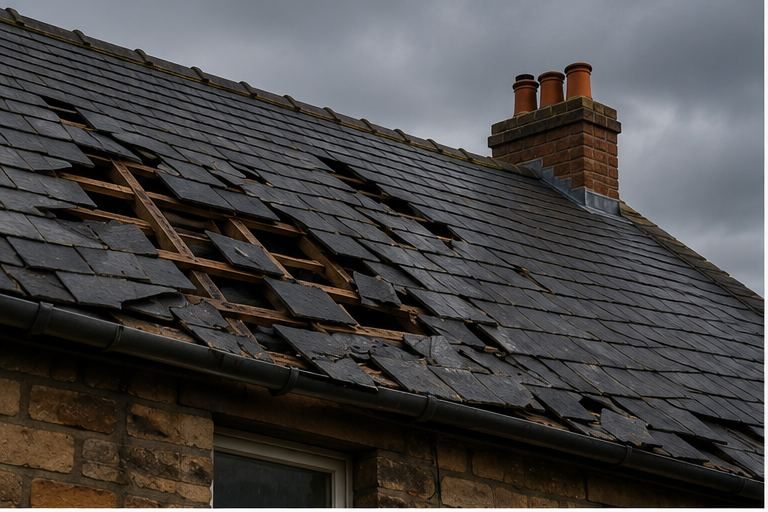
Mortar bedding can crack or crumble over time due to ordinary weathering, and once it has weakened, a storm can be enough to shift or dislodge a ridge or hip tile that would otherwise have stayed firmly in place. Because these tiles sit at the highest and most exposed points of the roof, they experience some of the strongest wind forces during a storm, which is part of why ridge and hip damage is such a frequent finding after severe weather. A ridge tile that has simply shifted sideways, rather than falling completely, can be just as significant a weak point as one that has come off entirely, since the seal along that section of ridge is broken either way.
A dislodged ridge tile is not purely a cosmetic problem. It creates a gap at the very apex of the roof where water can enter directly into the roof void, and because ridge tiles run along a horizontal line at the top of the structure, a single failure point can sometimes allow water to travel sideways under adjacent tiles before it becomes visible as a leak. Hip tiles carry a similar risk on the sloped edges of a roof, particularly on the many hipped-roof properties found across Downend.
Repairing storm-damaged ridge or hip tiles usually involves re-bedding the affected tiles in fresh mortar, or in some cases replacing tiles that have cracked, along with a check of the surrounding bedding to catch any other tiles that have weakened but not yet failed. Increasingly, mechanical fixing systems are used alongside or instead of mortar for a more storm-resistant result, something worth discussing with a roofer if this kind of damage has recurred more than once. Dry-fix systems, which clip ridge and hip tiles into place rather than relying purely on mortar, are becoming a popular choice for exactly this reason on more exposed Downend roofs.
Because ridge and hip damage is not always obvious from ground level, particularly on a taller or steeper roof, it is worth having this area specifically checked after any notably windy weather rather than assuming everything is fine simply because no tiles are visibly missing. A pair of binoculars from the garden can sometimes reveal more than a glance from the street ever will.
Brunel Roofing Bristol repairs storm-damaged ridge and hip tiles across Downend and can advise on more durable mechanical fixing options where mortar bedding has repeatedly failed, with free inspections offered to assess the roof properly first.
Need Emergency Roof Repairs in Downend?
Every case is different — the fastest way to get an accurate answer is a quick chat with our team.