
Whether a roof in Henbury is finished in traditional slate or a more modern concrete or clay tile, storms tend to attack both coverings in broadly similar ways, even if the specific failure points differ slightly between the two materials involved. Knowing what to expect helps homeowners recognise damage sooner rather than later, when it's easier and cheaper to put right. Interlocking concrete tiles, common on many newer Henbury roofs, generally hold up slightly better in wind than plain tiles simply because of how they lock together along each course.
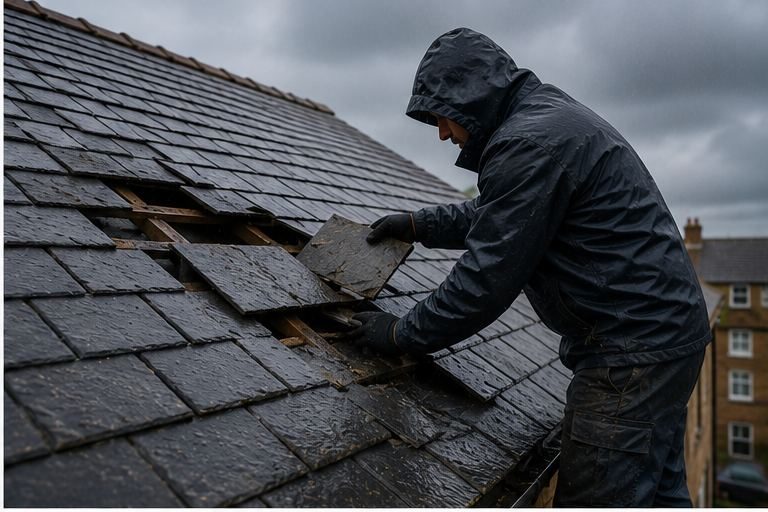
Slate roofs typically fail at the fixing point, with nails or hooks corroding over decades until a strong gust is enough to lift a slate free entirely, or displace it just enough to let water past the overlap with the slate below it. Tile roofs, meanwhile, are more prone to cracking under wind pressure or impact from debris, particularly older clay tiles that have become more brittle with age and less able to flex under sudden, sharp stress from wind or debris. Natural slate, by contrast, relies almost entirely on its fixings rather than its shape, which is why fixing failure, rather than the material itself breaking, is the more common cause of loss.
Both materials share a common vulnerability at the edges and ridge of the roof, where individual pieces are most exposed to wind uplift, which is why ridge tiles, hip tiles and roof edges are often among the first things checked after a storm has passed through Henbury, regardless of the main roofing material used across the rest of the roof slope beneath them. A storm can also loosen tiles without breaking them outright, leaving them sitting slightly proud of their neighbours, a subtle sign that's easy to miss without a close inspection.
Repairing a damaged slate or tile roof properly means matching replacement pieces to the existing covering wherever possible, since a mismatched patch stands out and can also behave slightly differently under weather stress than the surrounding original material, particularly in terms of thickness, weight or profile, which can genuinely affect how the repair performs over the following years. Colour variation between old and newer tiles is a normal part of ageing, and a good roofer will often use slightly weathered reclaimed stock rather than pristine new tiles for this reason.
On some of Henbury's older properties, storm damage can also reveal that the roof covering as a whole is approaching the end of its useful life, in which case a roofer should be upfront about whether targeted repairs remain sensible or whether a wider conversation about the roof's condition is worth having sooner rather than waiting for the next storm to force the issue. Where a roof has already been part-replaced in previous years, storm damage can sometimes highlight the join between old and newer coverings as a particular weak spot.
If your slate or tile roof has taken storm damage, an inspection will clarify exactly what's needed. Brunel Roofing Bristol offers free, no-obligation quotes for homes across Henbury and can advise honestly on the best way forward.
Need Emergency Roof Repairs in Henbury?
Every case is different — the fastest way to get an accurate answer is a quick chat with our team.