
It might seem like tiles simply get blown off during a storm, but the reality is a bit more specific, and understanding the mechanism helps explain why some tiles fail while others on the same roof, seemingly exposed to the same wind, stay perfectly in place throughout.
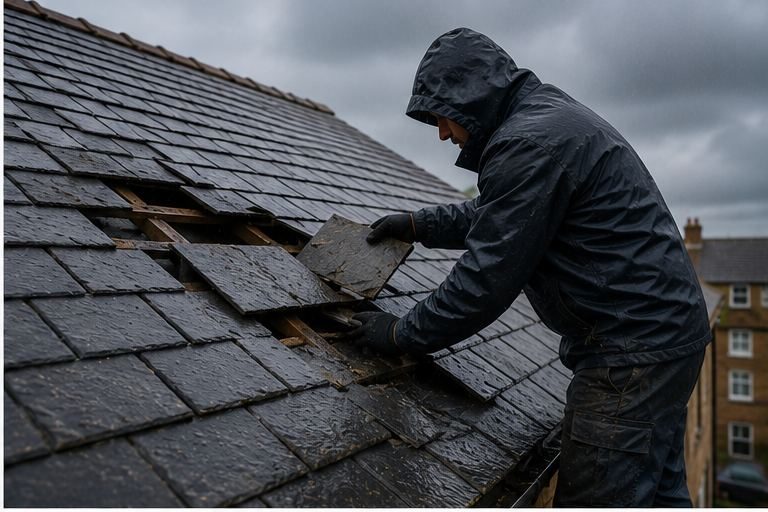
Wind moving over a roof surface creates areas of pressure and, more importantly, areas of suction, particularly along edges, at corners, and around any protruding feature such as a chimney. Where this suction effect is strong enough, and where a tile's fixing has any weakness at all, whether that's a nail that's corroded, a clip that wasn't perfectly seated, or simply age-related wear, the tile can be lifted just enough for wind to get underneath it and force it further out of position entirely.
Once a tile starts to lift even slightly, the problem tends to compound quickly. Wind getting underneath one displaced tile creates more turbulence and lift around neighbouring tiles too, which is part of why storm damage often appears as a small cluster of affected tiles rather than a single isolated one, particularly in an exposed spot such as a corner or edge facing the prevailing wind direction. Roof pitch plays a role as well. Steeper roofs generally shed wind more effectively than shallow ones, since the angle helps deflect rather than trap air moving across the surface, whereas flatter pitches and certain roof shapes can be more prone to the kind of turbulence that lifts tiles during a genuinely severe gust, particularly around dormers or extensions with a shallower slope.
Existing wear is a significant factor too. Tiles nearing the end of their expected lifespan, or fixed with materials that have deteriorated over time, are considerably more likely to lift during a storm than a well-maintained, relatively young roof covering, even when both are exposed to identical wind conditions on the same day and side of the same street. It's also worth noting that a single severe gust rarely tells the whole story. Roofs are more often weakened gradually across several storms over a number of years, with each one loosening fixings a little further, until a tile that finally lifts and comes free was in fact already close to failing well before that particular storm arrived.
Understanding why tiles lift doesn't change the immediate priority once it's happened, which is getting the exposed area protected quickly, but it does help explain why a repair sometimes involves checking and refitting neighbouring tiles too, rather than simply replacing the ones that are visibly missing. None of this means every roof is destined to lose tiles eventually. Good original installation and periodic maintenance both make a genuine difference to how well a roof stands up to repeated storms over the years.
If a storm has lifted or dislodged tiles on your Bromley Heath roof, Brunel Roofing Bristol offers free inspections to establish exactly why it happened and what needs repairing, along with 24-hour emergency call-out where the damage needs immediate attention.
Need Emergency Roof Repairs in Bromley Heath?
Every case is different — the fastest way to get an accurate answer is a quick chat with our team.