
One of the more confusing aspects of a roof leak, for homeowners in Easton and elsewhere, is discovering that the damp patch on a ceiling is not actually located beneath the point where water is entering the roof. This is a genuinely common occurrence rather than an unusual one, and understanding why it happens makes the whole process of diagnosing and repairing a leak considerably easier to follow.
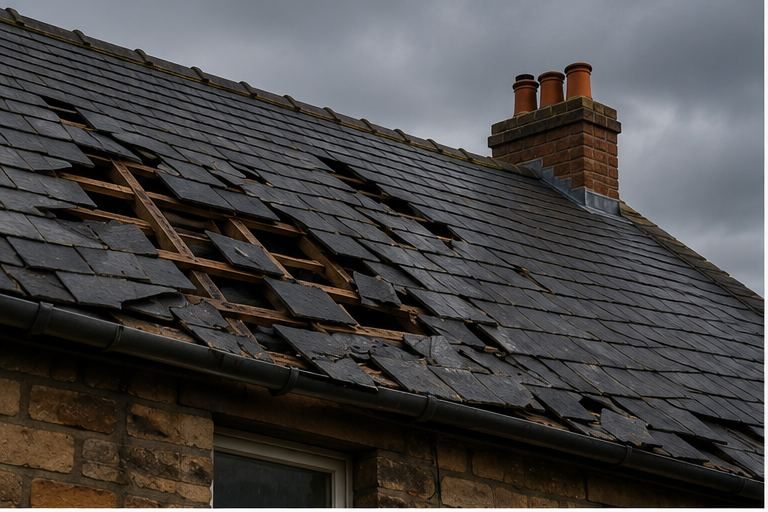
A roof is not a single flat, solid surface from the outside covering to the ceiling below. Beneath the tiles or slate sits an underlay or sarking felt, and beneath that, timber rafters, battens and, in many properties, roof boarding, all arranged with a slight pitch. Water that finds its way past the outer covering does not necessarily drop straight down through all of these layers at the entry point. Instead, it can run along the underlay, follow the line of a rafter, or travel across a section of roof boarding before finally finding a gap, a nail hole, or a low point where it drips through into the loft space or ceiling below. The pitch of the roof itself plays a part too, since even a gentle slope is often enough to carry water a reasonable distance sideways or downwards before gravity finally wins out at a weak point in the structure below.
This means the visible sign of a leak, whether that is a stain on a ceiling or a damp patch on a wall, can be some distance, sometimes a metre or more, from the actual point where water first entered the roof structure. On older Easton terraces with original timber roof structures, this effect can be even more pronounced, since decades of settlement and previous repairs can create channels along which water preferentially travels.
This is exactly why a competent roofer will not simply patch the roof directly above a ceiling stain and assume the job is done. Proper diagnosis typically involves checking the wider area of roof, looking at flashing, valleys, tile or slate condition, and the underlay itself over a broader area than the ceiling damage alone might suggest, sometimes with the help of a loft inspection during or shortly after rainfall to see exactly where water is entering. Staining that follows the line of a rafter, rather than sitting in a single rounded patch, is often a useful clue that water has travelled some distance before dripping through.
Understanding this also explains why a repair that seems to address the visible symptom sometimes fails to actually stop the leak, if the true entry point was never identified in the first place, which is a frustrating but avoidable outcome with a thorough initial inspection.
If your Easton property has a leak that seems to appear in a puzzling location, Brunel Roofing Bristol can carry out a proper diagnostic inspection to trace the actual source before recommending any repair.
Need Emergency Roof Repairs in Easton?
Every case is different — the fastest way to get an accurate answer is a quick chat with our team.