
The elegant Victorian and Georgian terraces around The Downs are, for the most part, roofed in natural slate, a material that's stood up to the city's weather for well over a century in many cases but that still has its limits when a genuinely severe storm arrives. Wind damage here tends to follow a fairly recognisable pattern once you understand how slate actually fails over time and repeated exposure. Even slate that's outlasted several previous owners of a property can reach a point where a single severe storm exposes just how much life the original fixings had left.
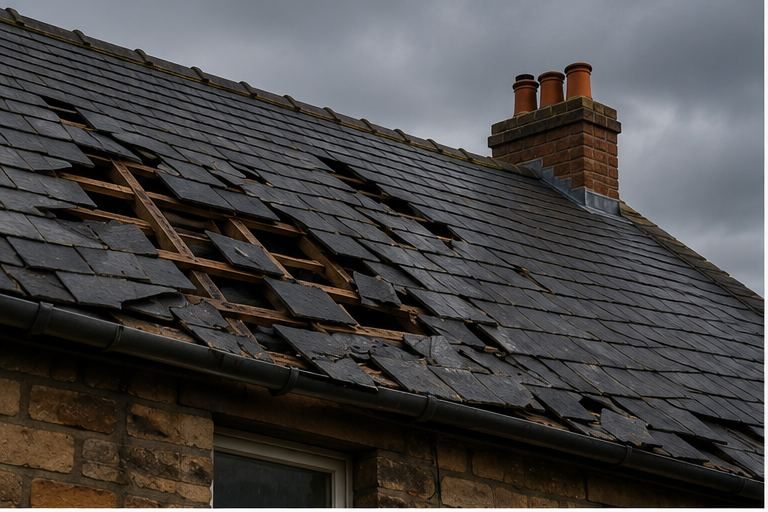
Slate is fixed with individual nails or hooks, and it's usually the fixing rather than the slate itself that gives way first, corroding gradually over decades until a gust that wouldn't have troubled a newer fixing is enough to work a slate loose or send it sliding off the roof entirely onto the ground below. A storm often finishes off a weakness that's been developing quietly for years beforehand without anyone noticing. This gradual process means a roof can look entirely unremarkable for years right up until the storm that finally causes visible loss, which can make the timing feel sudden even though the underlying cause was slow.
Cracked slates are equally common, sometimes caused by direct impact from debris carried on the wind and sometimes simply from the material flexing beyond what it can take under sustained pressure. A cracked slate that stays roughly in place can still let water through along the crack, which makes it easy to miss from ground level even though it needs the same attention as a slate that's fully dislodged and gone. Checking for cracked slates after a storm generally means getting eyes close to the roof itself, since the crack line can be almost invisible from the ground even in good light.
Tiled sections, where present on later additions or extensions to these older properties, tend to fail differently, with ridge and verge tiles bedded in ageing mortar the most likely to work loose during high winds. This is particularly true along roof edges exposed to the open ground near The Downs itself, where the wind has a clear run at the property. Where these tiled sections meet the original slate roof, the junction itself is often a point worth checking carefully, since two different materials ageing at different rates can create a weakness right at the join.
Matching replacements carefully, in material, colour, and thickness, matters more on these period roofs than on a modern uniform tile, since a mismatched repair is considerably more visible on a natural, slightly irregular material like slate than it would be on a mass-produced covering.
If wind has damaged slate or tiles on a property around The Downs, Brunel Roofing Bristol can carry out a carefully matched repair, with a free inspection and quote provided first before any work is agreed or scheduled.
Need Emergency Roof Repairs in The Downs?
Every case is different — the fastest way to get an accurate answer is a quick chat with our team.