
There is a meaningful difference between rain falling straight down and rain being driven sideways by strong wind, and Hotwells' exposed position near the river and the higher ground around it means properties here experience more than their fair share of the latter. Wind-driven rain behaves quite differently on a roof, finding its way under tile laps, past flashing edges and through gaps that would never trouble a roof in calmer, more vertical rainfall. This is one reason a roof that has coped well for years can suddenly develop a leak during one unusually wild storm.
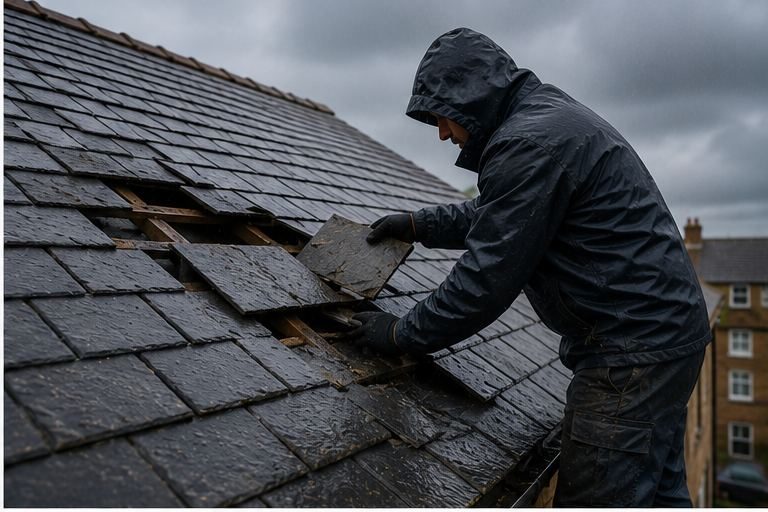
This is why a roof can perform perfectly well through months of ordinary weather and then develop a leak during a single storm where rain is being pushed almost horizontally against the building. Junctions and edges that rely on gravity alone to shed water, such as the lower edge of a piece of flashing or the overlap between two tiles, can be overwhelmed when water is being forced upward or sideways into them by wind pressure rather than simply running down and off the roof, particularly where fixings have loosened slightly with age over the years.
Roof edges and verges are particularly vulnerable to this kind of weather, since they sit at the boundary of the roof covering and can allow wind-driven rain to get behind the edge tiles if the detailing has weakened over time. Valleys, where two roof slopes meet, are another common weak point, as wind can push water back up the valley against the direction it is designed to flow, sometimes forcing it beneath the tiles on either side rather than letting it drain away normally.
Diagnosing a leak caused by wind-driven rain can be trickier than a straightforward failure, since the roof may show no obvious sign of damage and the leak might only appear during specific weather conditions, making the timing of an inspection genuinely useful information for a roofer to know when planning the visit. Describing exactly what the weather was doing when the leak first appeared helps narrow down where to look, and any pattern noticed over several storms is worth mentioning too.
Repairs typically focus on improving the weather resistance of the specific junction or edge that has been overwhelmed, whether that means renewing flashing, adjusting how tiles overlap at a vulnerable edge, or clearing and resealing a valley, rather than an assumption that the whole roof covering has failed. This targeted approach usually resolves the problem without the cost of a much larger, unnecessary repair.
If your Hotwells home has developed a leak that only seems to appear in wind-driven rain, Brunel Roofing Bristol can carry out an inspection to identify the specific weak point and provide a free quote for putting it right. Noting exactly which weather conditions triggered the leak beforehand helps make that follow-up inspection as efficient and accurate as possible.
Need Emergency Roof Repairs in Hotwells?
Every case is different — the fastest way to get an accurate answer is a quick chat with our team.