
A roof rarely fails in the middle of an open, uninterrupted slope. In our experience working on properties around Chipping Sodbury, it is almost always the junctions, the points where one roof plane meets another, or where the roof meets a chimney, wall, or dormer, that cause problems first. Getting these details right during a re-roof matters just as much as the choice of tile or slate covering the main areas.
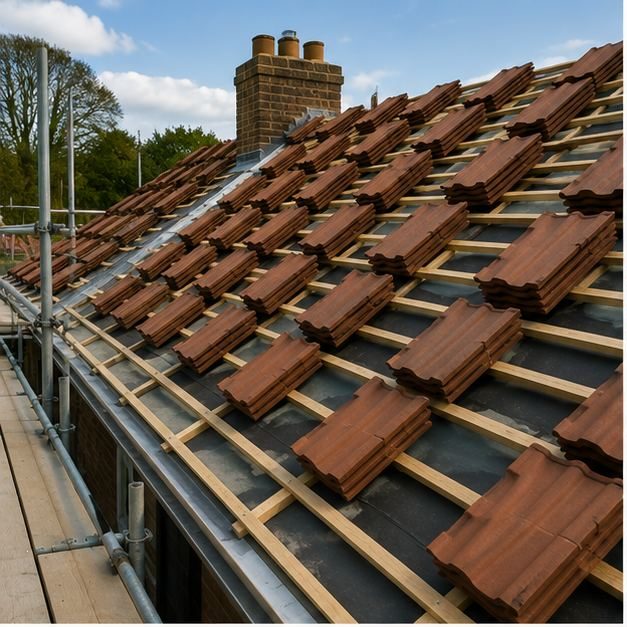
Valleys, where two roof slopes meet at an angle, are one of the most important junctions to get right. Water from both slopes concentrates in the valley, so it needs a properly formed valley gutter, whether that is lead, a valley tray system, or purpose-made valley tiles, laid so that water is carried away without pooling or being forced back under the surrounding tiles during heavy rain.
Abutments, where a roof meets a vertical wall such as a chimney stack or the wall of an adjoining extension, rely on stepped flashing to stay watertight. Each course of flashing needs to be dressed into the brickwork or pointed in correctly, overlapping the course below so that water is always directed outward and downward rather than finding a way behind the flashing and into the roof structure.
Ridges and hips also count as junctions in their own way, since they are where opposing roof planes meet at the top or along a diagonal. These are usually finished with bedded or dry-fix ridge and hip tiles, and the method chosen affects how well the junction copes with wind as well as rain, particularly on the more exposed roofs found on the edges of Chipping Sodbury.
Verges, where a roof meets a gable wall, are another junction that is easy to overlook. A dry verge system, using purpose-made plastic or clay units, tends to hold up better over time than a traditional mortar verge, which can crack and shed pieces as it ages, allowing wind and rain to work their way in along the edge of the roof.
Junctions around soil pipes, vents, and other roof penetrations also need proper attention during a re-roof, using purpose-made flashing collars rather than sealant alone. Sealant can look like an adequate fix in the short term, but it degrades with UV exposure and temperature changes far faster than a properly fitted mechanical flashing does.
The underlay laps at each junction matter just as much as the visible flashing above. Where the breathable membrane meets a valley, an abutment, or a penetration, it needs to be dressed and lapped correctly so that any water which does get past the outer covering is still carried safely down to the guttering rather than pooling against a timber or masonry junction out of sight beneath the tiles.
A re-roof is the best opportunity to put right any junctions that have caused problems in the past, since the whole roof is being stripped back and rebuilt rather than patched. Brunel Roofing Bristol pays particular attention to valleys, abutments, and hip lines on every re-roof we carry out in Chipping Sodbury, because that is where a roof's long-term performance is really decided. Contact us to discuss the junctions on your own roof.
Get a Free Quote for New Roof Installations in Chipping Sodbury
Every roof is different — the fastest way to get an accurate answer is a quick chat with our team.