
Chimney stacks are a familiar feature of the St Pauls skyline, standing tall above rows of period terraces and townhouses even where the fireplaces beneath them are no longer in daily use. Whether or not a chimney is still connected to a working flue, the point where it passes through the roof remains one of the most demanding junctions on the entire structure, and it depends almost entirely on correctly installed lead flashing to stay watertight through every season.
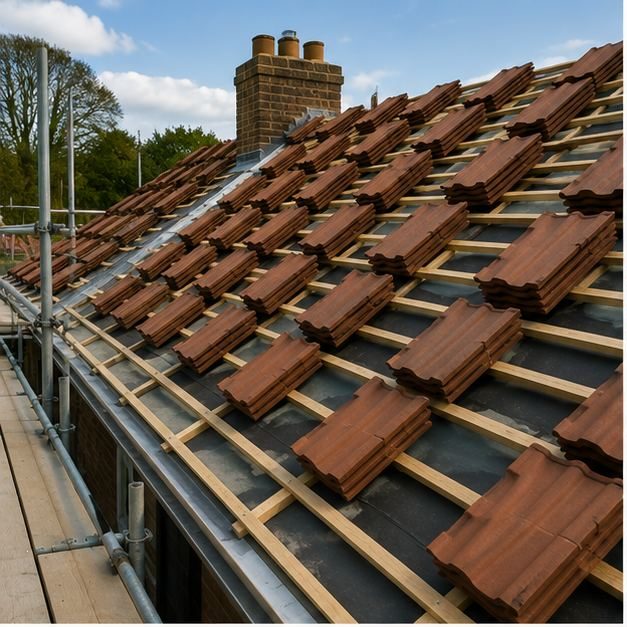
A chimney typically needs several separate pieces of leadwork working together: a front apron facing down the slope, stepped flashing running up each side, soakers woven between the tiles or slates immediately around the stack, and a back gutter behind the chimney to channel water that would otherwise pool against the brickwork. If any one of these elements has failed, water can enter even while the rest of the roof and the visible flashing appear entirely sound to an untrained eye.
Because chimneys project through the roof and are exposed to wind and rain from every direction, their flashing tends to suffer more than flat sections of the roof covering nearby. Mortar around the base can erode, brickwork can move slightly with age and settlement, and the flashing itself can pull away or crack as a result. On older St Pauls properties where a chimney has been standing for well over a century, this wear is often more advanced than it looks from street level, and the true condition only becomes clear on close inspection.
During a full roof replacement, Brunel Roofing Bristol treats chimney flashing as a priority rather than a minor add-on tacked onto the end of the job. Old leadwork is stripped away, the surrounding brickwork is checked and repointed where needed, and new soakers, apron and back gutter are fitted as an integrated part of the re-roof, so the chimney is dealt with properly rather than left as a weak point in an otherwise brand new roof covering.
Some homeowners in St Pauls consider having a disused chimney stack removed altogether rather than reflashed, and this can be a reasonable option in the right circumstances, but it comes with its own structural and detailing considerations, including how the resulting gap in the roof is properly covered and tied into the surrounding tiles or slates. Either way, the decision is best made before a new roof goes on, not after, since retrofitting either choice later usually means disturbing a roof that has only just been completed.
Even where a chimney is purely decorative and no longer used for a fire, leaving its flashing unaddressed during a re-roof simply postpones a future repair, often at greater expense once new tiles or slates have to be disturbed. If your St Pauls property has one or more chimney stacks, it is worth asking specifically how they will be treated as part of any new roof quote, and Brunel Roofing Bristol is happy to explain the approach before work begins.
Get a Free Quote for New Roof Installations in St Pauls
Every roof is different — the fastest way to get an accurate answer is a quick chat with our team.