
It is easy to overlook lead flashing entirely, which is probably a compliment to how well it usually does its job. The strip of lead that runs around the base of a chimney where it meets the roof slope is doing quiet, unglamorous work: bridging the join between two different surfaces so that water running down the roof, and water running down the stack, both end up on the tiles rather than inside the loft. It is easy to walk past a chimney for years without ever giving the flashing a second thought, right up until the point it fails and a damp patch appears somewhere inside the house.
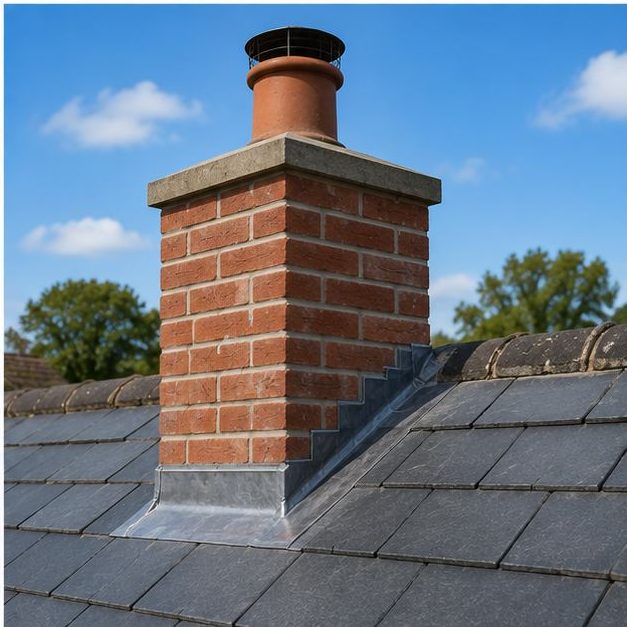
A proper flashing installation actually involves several parts working together. There is the main apron or step flashing along the front and sides of the stack, soakers tucked individually under each course of tiles to carry water past the joints, and often a back gutter behind the chimney to catch and redirect the larger volume of water that runs down the roof above it and would otherwise pool against the brickwork. On many Eastville properties, particularly where a chimney sits partway up a longer roof slope, that back gutter is doing more work than people realise, since it has to cope with the combined runoff of the whole area of roof above the stack rather than just its own immediate surroundings.
Lead itself is a genuinely long-lasting material, but it does not last forever, and it does not fail in isolation. Movement in the roof structure, decades of thermal expansion and contraction, and simple weathering can all cause flashing to lift at the edges, crack, or pull away from the mortar joint it was originally dressed into. Once that seal is broken, water finds its way in surprisingly easily, even through a gap you would struggle to see with the naked eye. This is part of why flashing problems often go unnoticed for a while: the failure itself can be small and gradual, even though the water damage it eventually causes indoors is not.
A common mistake, and one we see fairly often when called out to investigate a leak, is a previous repair done with mastic or sealant rather than proper leadwork. It looks fine for a season or two, then the sealant perishes, shrinks, or cracks in the sun, and the leak returns, sometimes worse than before because the underlying lead has been disturbed. Genuine flashing repairs mean re-dressing or replacing the lead itself and re-securing it properly into the joint, not smearing something over the gap.
If you have a damp patch appearing near a chimney breast, or you can see daylight or lifted lead when looking up at the stack, it is worth having it looked at before the next spell of heavy rain rather than after. Brunel Roofing Bristol can inspect the flashing, soakers and back gutter as a complete system and carry out a proper lead repair rather than a temporary patch, all covered by our 15-year guarantee.
Get a Free Quote for Chimney Repairs in Eastville
Every chimney is different — the fastest way to get an accurate answer is a quick chat with our team.