
A damp patch appearing near a chimney breast is one of the more frustrating problems a homeowner can face, mainly because the obvious assumption — that the leak is directly above the stain — is wrong more often than people expect. Water has a habit of entering at one point and travelling along a rafter, a batten, or the inside of a flue liner before it finally shows itself somewhere else entirely. It is a common source of confusion, and understandably so, since the most natural instinct is to assume the ceiling directly beneath the stain is where the problem must lie.
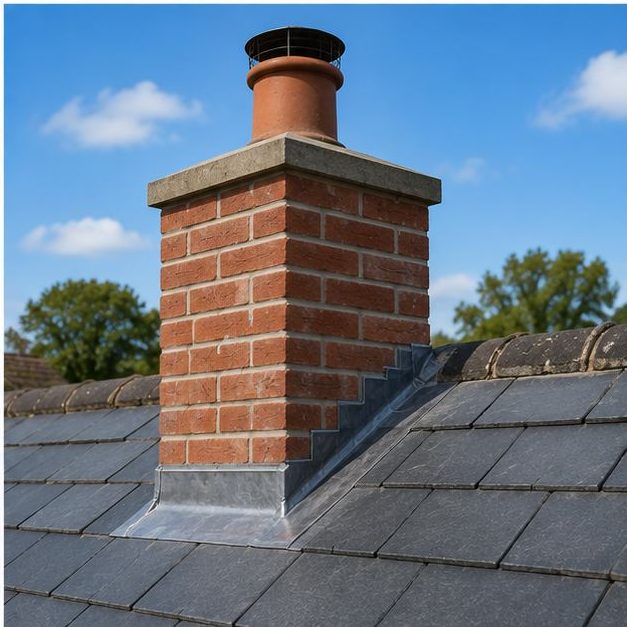
There are several places on and around a chimney where water commonly gets in. Flashing and soakers at the base of the stack are the most frequent culprit, particularly once the lead has lifted or the mortar joint it was dressed into has eroded. Cracked or missing flaunching at the top of the stack lets water track straight down inside the flue. Spalling or porous brickwork, where the surface of the brick has started to break down after years of frost damage, can let moisture soak through the wall of the stack itself rather than around it. Even a poorly fitted or missing cowl can allow driving rain straight down an open flue. Any one of these on its own can be enough to cause a persistent leak, which is why ruling causes in or out one at a time matters more than guessing at the most obvious-looking culprit.
Tracing which of these is actually responsible takes a proper visual inspection of the stack from close up, ideally combined with a look at the loft space where the flue passes through, checking for staining patterns that give clues about the water's actual path. On taller Eastville terraces this usually means access via ladder or scaffold rather than trying to diagnose the problem from the ground, since so much of the relevant detail — hairline cracks in flaunching, lifted flashing edges, degraded mortar — simply isn't visible from below. Checking the loft space at the same time, looking for staining along rafters or battens near the chimney, often provides useful clues about the direction water has actually travelled before it showed itself.
Guessing at the cause and re-sealing the first thing that looks suspicious is a common but costly mistake, because if the guess is wrong the leak continues, the same repair gets tried again, and the property owner ends up paying twice for a job that a proper trace would have solved the first time. It is also worth remembering that a leak left untreated for long enough can spread damage well beyond the original entry point, affecting timber, insulation and plasterboard as it goes.
If you have a persistent leak that seems connected to a chimney but you are not sure exactly where it is coming from, that is precisely the kind of problem a proper inspection is designed to solve. Brunel Roofing Bristol will trace the actual source before recommending any repair, so you are fixing the real problem rather than the nearest guess. Get in touch for a free inspection.
Get a Free Quote for Chimney Repairs in Eastville
Every chimney is different — the fastest way to get an accurate answer is a quick chat with our team.