
Cracks in a chimney stack tend to alarm homeowners more than almost any other roofing issue, and for good reason, since a stack sits well above head height on properties across Lawrence Weston and any doubt about its stability is not something to leave unchecked. The good news is that not every crack means the stack is failing structurally — but telling the difference between harmless surface weathering and something more serious is exactly the kind of judgement call that benefits from a professional eye rather than guesswork from the ground.
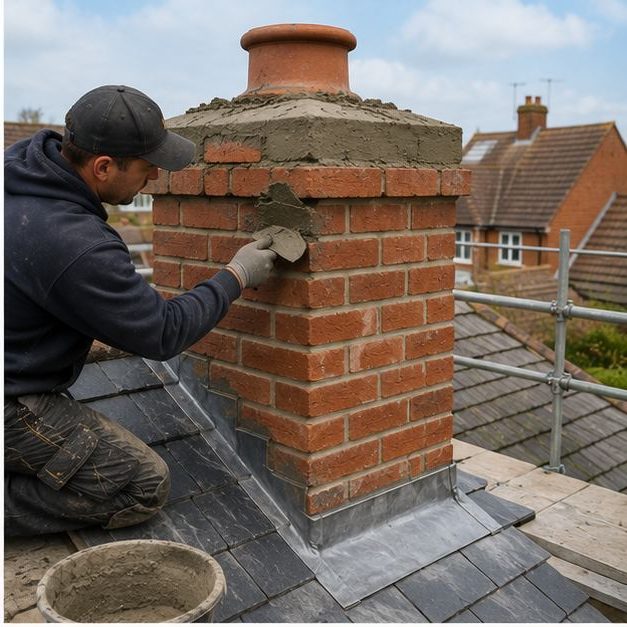
Hairline cracks confined to the mortar joints, rather than running through the bricks themselves, are usually a sign of ordinary weathering and mortar fatigue, the kind of thing that repointing addresses on its own. These are common and rarely urgent, though they are worth fixing before water gets further into the joint and accelerates the damage over successive winters. A useful check is whether the crack follows the line of the mortar joints in a stepped pattern or cuts straight across bricks and joints alike — the former is generally the less concerning of the two.
Cracks that run vertically or diagonally through several courses of brick are a different matter. These often point to movement in the stack itself — sometimes caused by a failed or missing damp proof course allowing sulphate attack on the mortar, sometimes by foundation movement, and sometimes simply by decades of thermal expansion and contraction working a weakness loose. A stack showing this kind of cracking, particularly if it is combined with any visible lean, needs a proper structural assessment rather than a cosmetic patch. Sulphate attack in particular is worth understanding, since it happens when moisture reacts with sulphates in the brick or flue gases, gradually expanding the mortar joints from within and pushing the brickwork apart in a way that repointing alone will not resolve.
The repair route depends entirely on what is found. Isolated cracked bricks can sometimes be cut out and replaced individually, with the surrounding joints repointed to match. Where cracking is more widespread, or where the stack shows signs of leaning or bulging, a partial rebuild — taking the stack down to sound brickwork and rebuilding upward with matching materials — is often the safer and more cost-effective option than repeatedly patching a structure that keeps moving.
Storm damage is worth a specific mention too, since a sudden crack appearing after high winds in Lawrence Weston is a different situation to gradual weathering, and can sometimes indicate the stack has been knocked or partially dislodged, which should be treated as urgent until it has been checked.
Because getting this wrong has real safety implications, any chimney showing cracking beyond simple mortar wear is worth having assessed properly. Brunel Roofing Bristol provides free inspections to establish exactly what is going on, along with a 24-hour emergency call-out for anything that looks unsafe, and all repair or rebuild work is covered by our 15-year guarantee.
Get a Free Quote for Chimney Repairs in Lawrence Weston
Every chimney is different — the fastest way to get an accurate answer is a quick chat with our team.