
Older roofs across Clifton have generally been built to last, but decades of weathering mean that even a relatively ordinary spell of high wind can expose weaknesses that would not trouble a newer roof covering. Because much of the damage that follows high winds is not immediately obvious, knowing the early signs to watch for can help homeowners catch a developing problem well before it becomes a significant leak or a costly repair.
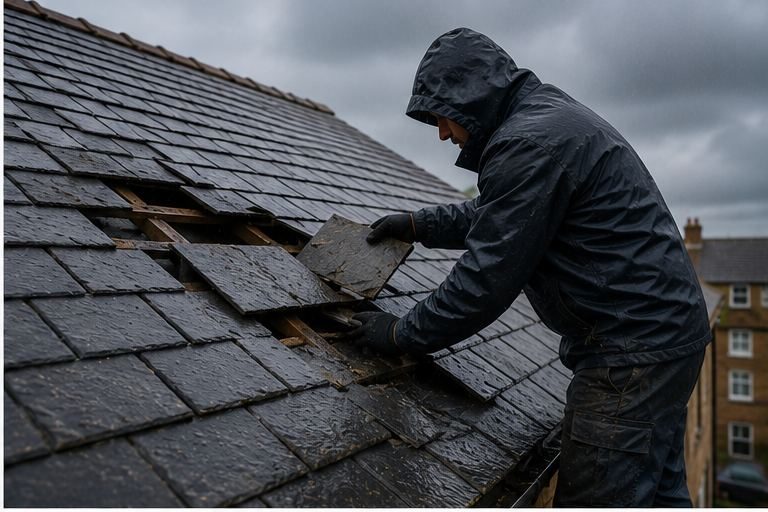
From ground level, the most straightforward sign is a change in the roofline itself: a slate or tile that now sits at a slightly different angle to its neighbours, a visible gap where a slate has slipped, or debris in the guttering that suggests something has come loose. On taller Clifton terraces this can be harder to spot without binoculars or stepping back from the property, but it is still worth a periodic look after any notably windy weather.
Guttering and rainwater goods are also worth checking, since wind can dislodge sections of gutter or downpipe even when the roof covering itself is undamaged, and a compromised gutter run can allow water to overflow against the wall or soffit rather than draining away properly. On period properties this can be particularly relevant where original timber soffits and fascias are still in place and more vulnerable to prolonged damp than modern replacements. A gutter bracket that has come loose in the wind, allowing a section to sag or pull away from the fascia, is easy to overlook but can direct a surprising volume of water against the brickwork over time.
Inside the property, a torch check of the loft after high winds can reveal problems well before they show up as a ceiling stain, including daylight visible through the roof structure, a fresh smell of damp, or dark marks on roof timbers or boarding. Because water can travel along rafters before dripping through in an unrelated spot, it is worth checking the whole loft rather than assuming any leak will be directly beneath its source. Where a loft has been partly converted or boarded over for storage, it is worth moving stored items occasionally to check the roof structure underneath, since damage can otherwise go unnoticed for a surprisingly long time.
Recurring issues are worth taking particularly seriously on older roofs, since a fixing or piece of flashing that has failed once under wind stress is statistically more likely to fail again during the next storm, rather than being purely a one-off event. A pattern of minor problems is often a more reliable signal that a fuller inspection is worthwhile than any single incident on its own, and it is worth keeping a rough mental note of repairs carried out over the years for exactly this reason.
If you have noticed any of these signs on a Clifton property, Brunel Roofing Bristol offers free inspections to check the condition of older roofs after high winds, with honest advice on what, if anything, needs attention.
Need Emergency Roof Repairs in Clifton?
Every case is different — the fastest way to get an accurate answer is a quick chat with our team.