
Severe weather leaves its mark on roofs in different ways, and rarely in the single, obvious form people sometimes expect. Across Shirehampton, storm damage can range from a scattering of tiles lost in a gust to a slow leak that only becomes apparent days after the wind has died down, and understanding the range of what a storm can actually do is a useful starting point for anyone dealing with the aftermath of a bad night's weather and trying to decide what to do next. Some storms cause damage that's immediately obvious from the street, while others leave a roof looking perfectly normal despite a genuine weakness having developed somewhere out of sight.
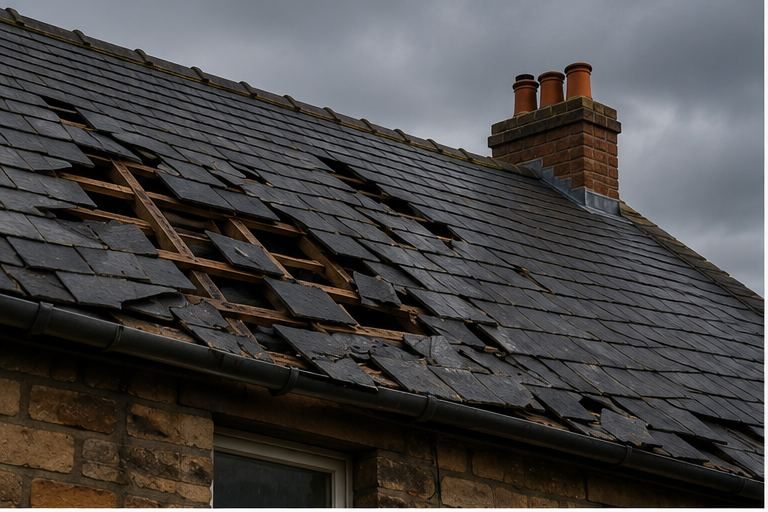
Wind is usually the main culprit, lifting and dislodging roof tiles or slate, working flashing loose around chimneys and junctions, and in some cases stripping sections of felt from flat roof extensions outright. Heavy rain compounds the problem by finding its way through any gap the wind has created, and fallen branches or debris carried by the storm can cause more localised, direct damage on top of that, sometimes cracking or puncturing a covering that would otherwise have coped fine with the wind alone. Even relatively small branches, carried at speed by strong gusts, can crack a tile or dent flashing in a way that only becomes a real problem once rain follows behind the wind.
Older housing stock, of which there's a fair amount across Shirehampton, can be particularly susceptible simply because roofing materials and fixings weaken gradually over the years, meaning a storm often finishes off a problem that was already quietly developing rather than creating an entirely new one from scratch. A roof that's coped with previous storms can still reach a point where the next one is the one that finally causes a visible problem indoors. This is particularly true of roofs that haven't had a proper inspection in several years, where small issues can accumulate quietly without ever quite reaching the point of an obvious leak until conditions align.
Repairing storm damage properly starts with a full assessment rather than just patching the most obvious fault, since wind rarely limits itself to a single point on a roof. That means checking tiles, ridges, valleys, and flashing together, and where necessary arranging temporary weatherproofing to stop further water ingress while a permanent repair is scheduled around materials and access requirements for the specific property. Where a roof has multiple coverings, such as a tiled main roof alongside a flat-roofed extension, each needs assessing on its own terms rather than assuming damage to one means the other has escaped.
The right approach depends heavily on what's actually happened to a given roof, and the extent of the damage, the materials involved, and how the property is built all play into both the repair method and the cost, which is why a proper inspection matters more than trying to diagnose the problem from ground level or by guesswork alone based on what's visible from the garden. A written quote sets out exactly what's included, so homeowners can make an informed decision rather than a rushed one.
If your Shirehampton property has been affected by a recent storm, Brunel Roofing Bristol offers free inspections and emergency call-out repairs, with a 15-year guarantee on completed work and honest advice on what actually needs doing rather than what's easiest to sell.
Need Emergency Roof Repairs in Shirehampton?
Every case is different — the fastest way to get an accurate answer is a quick chat with our team.