
Flashing is one of those roofing details that works quietly in the background for years, sealing the joints where a roof meets a chimney, wall or dormer, right up until heavy rain exposes a weakness that's been building for a while completely unnoticed. For homes across Hengrove, flashing failure is a common cause of leaks that seem to appear suddenly during a downpour, catching homeowners genuinely off guard when it happens. It's worth noting that flashing failures often coincide with a change in wind direction partway through a storm, since this can drive rain into a joint that's usually sheltered.
Lead flashing, the traditional material used for this job, can fail in a few ways: the mortar pointing that holds its top edge in place can crack and fall away, the lead itself can lift at the edges under wind pressure, or years of expansion and contraction through changing temperatures can eventually cause it to crease and split at a point of repeated stress that's built up over many seasons. Step flashing, used where a roof slope meets a vertical wall at an angle, has more individual joints than a single continuous run, giving it more potential points of failure.
Heavy rain puts more pressure on a weakened flashing joint than a light shower would, simply because there's more water trying to find its way through any gap, which is why flashing that's held up fine through months of ordinary weather can suddenly start leaking during one particularly heavy downpour that finally overwhelms the already compromised joint completely. A flashing repair carried out in genuinely wet conditions is rarely as effective as one done once the area has had a chance to dry out properly first.
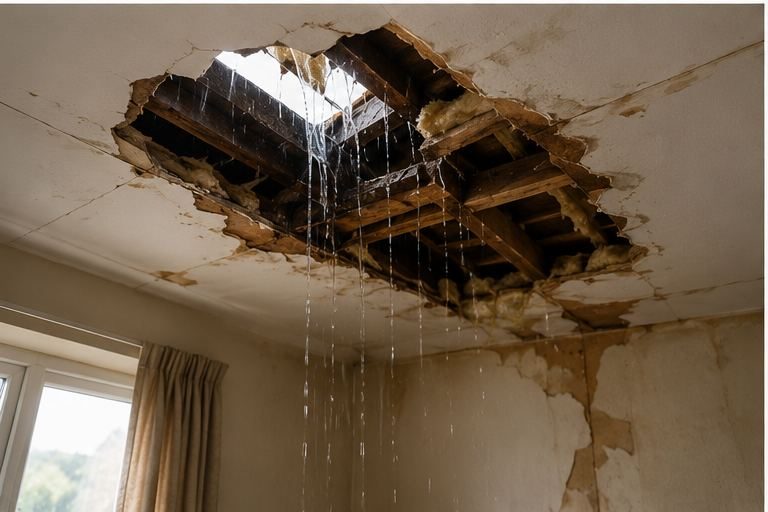
Because flashing sits at a junction rather than an open expanse of roof, water getting in here can travel a surprising distance down inside a chimney breast or wall cavity before it becomes visible as a stain or damp patch, often some distance from where the actual fault is genuinely located within the roof structure. Where flashing has failed more than once at the same spot, it's often worth checking whether the underlying brickwork or masonry itself has also been affected by ongoing damp.
A lasting repair means properly resealing or replacing the affected flashing, rather than relying on sealant as a quick fix, since sealant alone tends to fail again after further exposure to weather, leaving the same problem to resurface within a season or two, often at an equally inconvenient time as the last one was. A well-fitted flashing detail should be almost invisible once finished, blending into the roofline rather than standing out as an obvious repair on the property.
If heavy rain has exposed a flashing failure in your Hengrove home, Brunel Roofing Bristol can carry out a proper, lasting repair, with emergency call-out available to stop the immediate leak while the fuller fix is arranged.
Need Emergency Roof Repairs in Hengrove?
Every case is different — the fastest way to get an accurate answer is a quick chat with our team.