
Flashing rarely gets much attention until it fails, at which point it tends to announce itself with a leak around a chimney, roof junction or dormer window. For homes in Greenbank, particularly those with original lead flashing still in place from decades ago, high winds and driving rain are often what finally push an already weakened section past the point of holding water out. It's one of those roofing details that can look perfectly fine from a distance while quietly failing at the joint underneath, out of sight from ground level. It's the kind of detail a homeowner rarely thinks about until it's already causing a problem indoors, at which point the underlying cause is often several years in the making.
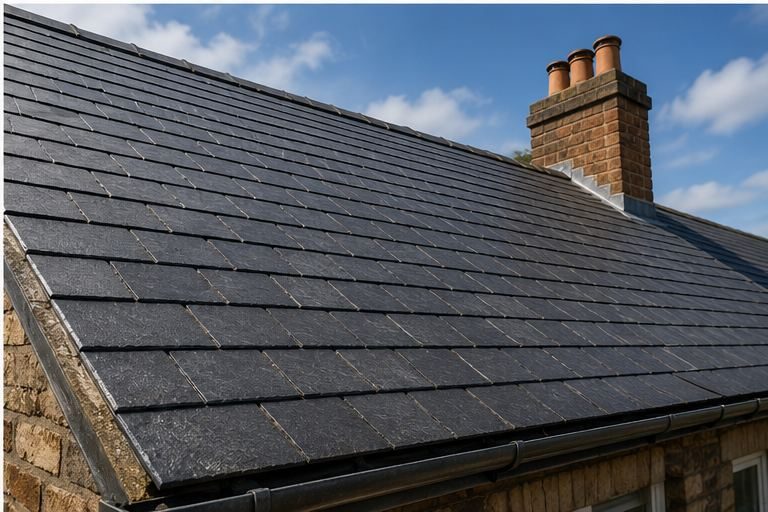
Lead flashing works by sitting tight against a chimney stack, wall or roof junction and directing water away from the joint rather than letting it collect there. Over time, wind can lift or peel back the edges, mortar pointing that holds the top edge in place can crack and fall away, or the lead itself can crease and split after years of expansion and contraction in changing weather. Even a small gap along the edge is enough to let a surprising amount of water through during a storm, particularly one with strong, gusting wind driving the rain sideways into the joint. This gradual failure is part of why flashing problems can be genuinely hard to predict from the outside, even for an experienced eye doing a routine check.
Because flashing sits at a junction rather than an open expanse of roof, a failure here can let in a surprising amount of water relative to the size of the gap, and that water often runs down inside a chimney breast or wall cavity before it becomes visible as a stain or damp patch well away from the actual fault. This can make flashing failures some of the more confusing leaks to diagnose without a proper roof-level inspection carried out by someone who knows exactly what they're looking for. It's also why a leak connected to flashing can seem to appear and disappear depending on wind direction, since only certain conditions push enough water through the compromised joint.
An emergency repair typically involves temporarily resealing or patching the affected section to stop water getting in immediately, with a permanent lead repair or replacement carried out once the extent of the damage has been properly assessed. On some older Greenbank roofs this reveals wider issues with surrounding tiles or pointing worth addressing at the same time, so the roof is left in a genuinely sound state rather than patched piecemeal and left with other faults still quietly present. Where several flashing details on the same roof have reached a similar age, finding one failure is often a useful prompt to check the others nearby at the same time.
Getting flashing repaired properly, rather than simply resealed with sealant as a quick fix, matters for the long-term integrity of the roof, since sealant alone tends to fail again within a season or two once exposed to further weather, meaning the same leak often resurfaces at the least convenient moment, usually during the next significant downpour to hit the area. This approach tends to work out more cost-effective in the long run than repeatedly calling a roofer back out for one failed section after another over successive years.
If you suspect flashing is behind a leak in your Greenbank home, Brunel Roofing Bristol offers 24-hour emergency call-outs to stop the immediate problem, followed by a proper lead repair carried out to last, backed by a 15-year guarantee on the finished work.
Need Emergency Roof Repairs in Greenbank?
Every case is different — the fastest way to get an accurate answer is a quick chat with our team.