
Where two sections of a roof meet at an angle, the valley formed between them carries a significant volume of rainwater away from the property, which makes it one of the most heavily worked parts of any roof during a storm. On properties across Eastville with more complex roof shapes, valleys are often the first place a genuine leak develops, simply because of how much water passes through that one channel compared with the flatter areas either side. This is especially true during longer storms, when the sheer volume of water passing through a single valley can exceed what the channel was ever designed to comfortably handle.
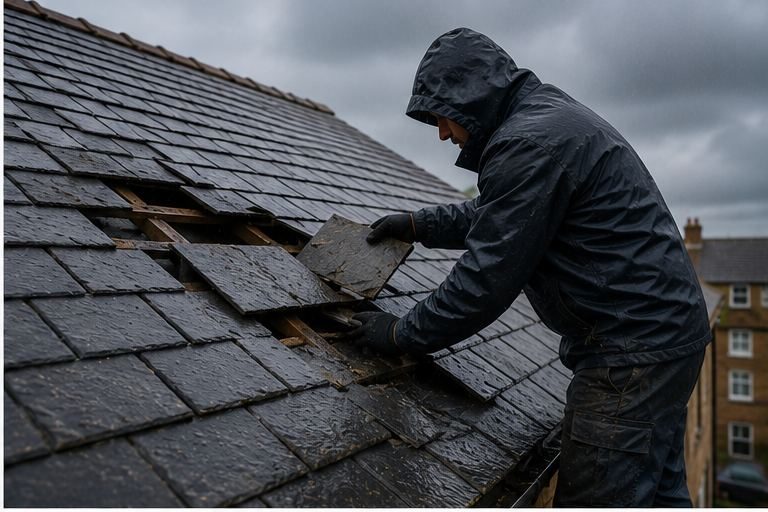
Valleys are usually lined with lead, or increasingly with GRP or fibreglass systems on more recent work, and it is the seal along the edges where the lining meets the surrounding tiles that tends to fail first. Wind can lift tiles near a valley just enough to let water track sideways underneath, while debris carried by wind, such as small branches or a build-up of leaves, can partially block the channel and cause water to back up and overflow during exceptionally heavy rain. On roofs with more than one valley, it is worth checking all of them rather than assuming a problem is isolated to the one that has already leaked.
A failing valley rarely announces itself clearly. Water that enters at this point can travel some distance along roof timbers before it shows as a stain on a ceiling, which means the visible damage indoors is not always a good guide to where the actual problem sits on the roof. This is part of why valley leaks are often mistaken for a problem elsewhere and can go on causing hidden damage for longer than more obvious issues like a missing tile. By the time a stain becomes visible on a ceiling, water may already have been finding its way past the valley lining for some time, quietly affecting timber that is not easy to inspect without opening up the area.
When a valley does fail during a storm, temporary weatherproofing is usually the first priority to stop the situation worsening while a permanent repair is scheduled. This might mean clearing debris that is causing water to pool, or fitting a temporary patch over a section of damaged lining, buying enough time to arrange a proper repair without the property being at ongoing risk in the meantime.
Permanent repairs generally involve replacing the damaged section of valley lining and resetting the surrounding tiles so the whole channel sheds water cleanly again, rather than simply patching over the immediate leak. On older Eastville roofs, this is also often a useful moment to check whether the rest of the valley lining is nearing the end of its working life, since a valley that has failed once is more likely to develop further problems nearby.
If a valley on your Eastville roof has started leaking or you have noticed water pooling after recent rain, prompt attention limits how much further damage occurs before the repair is carried out. Brunel Roofing Bristol provides emergency call-outs for exactly this kind of problem, alongside free inspections and quotes for the permanent repair work.
Need Emergency Roof Repairs in Eastville?
Every case is different — the fastest way to get an accurate answer is a quick chat with our team.